
 Brandee Fantini – Principal
 No matter the initiative, every proposed change is only as valuable as the activation behind it, including how work gets done, how employees own it, and how your customers experience it. Effective change leadership is critical to realize that activation.
One of the most effective ways to activate change is by creating new experiences. Change experiences are holistic, role-based, and business-driven practices that encourage people to carry change forward. Consistent change experiences foster new mindsets and behaviors over time, making it more likely the change will be fully adopted long-term and produce measurable results.
Even with this strategy in mind, organizational change can feel daunting. The change journey is bumpy and risky. The graphic below depicts the common performance dips employees often experience during the change journey:
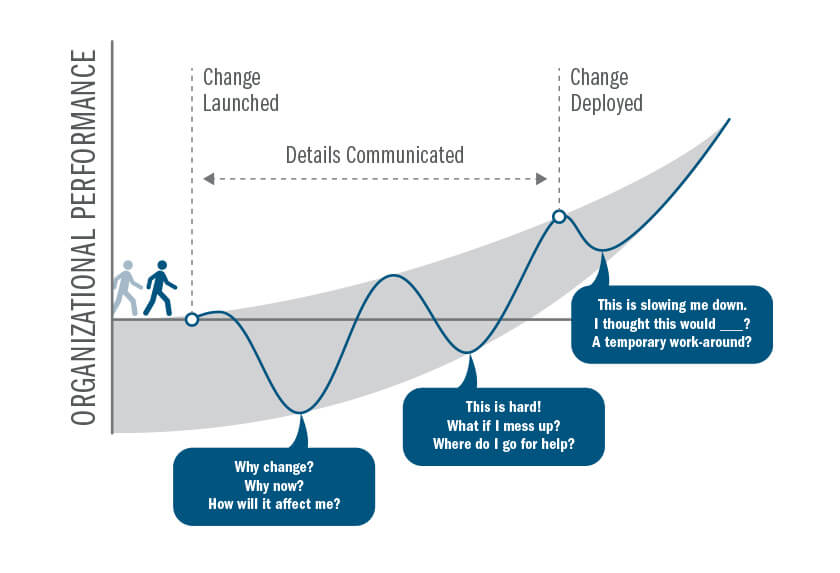
Effective change leaders guide people through this bumpy journey by helping mitigate the real and perceived barriers to adoption and focusing on the larger structural and organizational processes at play.
Change in the workplace can sometimes be experienced as a threat, whether to a person’s sense of status, certainty, autonomy, relationships, fairness, or something else. The human brain has a deeply established fight-or-flight response to perceived threats, which can lead to defensive or argumentative behaviors as people shut down, disengage, and avoid further conflict.
People can also perceive change as being wrong. When change is perceived as wrong, the brain is triggered into reacting with judgments and critical thoughts. Disagreement can persist on substantive grounds or it can devolve into nitpicking.
Most often, change isn’t quickly adopted because new ways of working simply take more time. People need space and time to practice working in new ways, form new connections in their brain, and repeat behaviors as they establish new habits and patterns.
Effective change leaders can lead a dialogue around both the justifications behind the change and the reasons it’s not being adopted. If employees aren’t adopting a new behavior, there’s likely a good reason. For example, if an employee learns that her manager wants her to cross-sell other products, but her compensation is based on selling a core set of products, why would she cross-sell other products if nothing is motivating or rewarding the new behavior?
Consider the following habits that effective change leaders practice. Where are you strong as a change leader? Where could you use more practice?
As the pace of change continues to accelerate, organizations need effective change leaders who adopt change quickly and enable others to do the same.
Are you going through organizational change? If you’d like to connect with our team to learn more about fostering effective change leadership, give us a call at 859-415-1000 or drop us a line.