
 Mike Lewis – Principal
 There is a category of AI proficiency that most organizations haven’t named yet—and it may be the most strategically important one.
Non-technical AI builders are those who fall between people who use AI tools and people who build AI-powered systems. In other words, they’re people who create reusable, automated solutions using AI—without writing code. The term “non-technical” removes the barrier that prevents most people from considering themselves “AI builders.”
What makes this category powerful is where these people sit within their organization. They rarely work in IT. Most often, they’re embedded in parts of the organization that understand the product, the client, and how the work gets done. AI has made it possible for anyone who understands the work to also systematize it—that’s what language models unlocked. The non-technical AI builder has figured that out, and most organizations have more of them within reach than they realize.
Geoff Charles, Chief Product Officer at Ramp, a multinational financial technology company, shared a four-level framework for classifying AI proficiency across every employee in a March 2026 interview with Peter Yang. The framework defines proficiency by observable behavior, rather than self-reported sentiment, and draws a clear line between people who use AI and those who build with it.
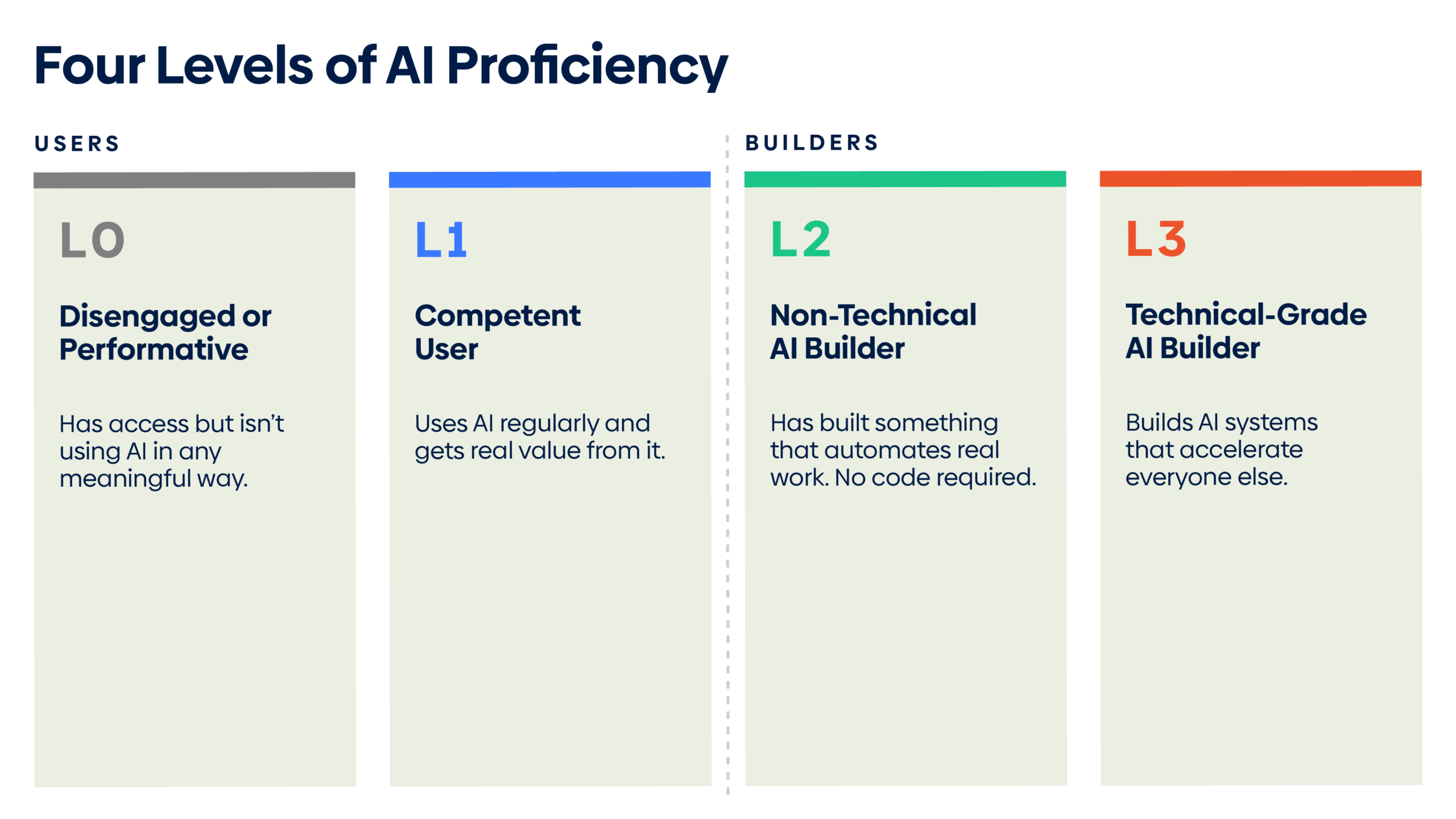
Here’s how Charles characterizes each level:
Level 0: Disengaged or Performative – An employee who has access to AI tools but isn’t using them meaningfully.
This includes people who attend training and use the right vocabulary but haven’t changed how they work. The gap between stated engagement and actual behavior change is one of the most common—and least visible—patterns in organizations.
Level 1: Competent User – An employee who uses AI regularly and gets real value from it.
Competent users know how to set context, prompt effectively, and validate results. A practical test: If you took this person’s AI tools away, would their work noticeably suffer? For most knowledge workers, this should be the floor.
Level 2: Non-Technical AI Builder – An employee who has built something reusable that automates meaningful work—no coding required.
Competent users make themselves faster. Non-technical AI builders make a process faster—for themselves and potentially for others. This missing middle is the least recognized and most underleveraged capability in most organizations.
Level 3: Technical-Grade AI Builder – An employee who builds AI systems and infrastructure that accelerate everyone else.
The difference between Level 2 and Level 3 is the person’s scope of impact, not skill level. An organization doesn’t need many technical-grade AI builders, but this group shapes what’s possible for the entire organization.
Each level is defined by what someone does, not how they feel about AI. Self-reported comfort correlates poorly with actual behavior. Disengaged employees tend to overreport their engagement, while genuine builders often underreport because they don’t realize what they’ve done counts as “building with AI.” Organizations don’t need a better survey to measure AI usage. They need a way to observe AI-enabled behaviors and compare those against clear criteria.
Most people assume the hardest transition is moving from Level 0 to Level 1—getting disengaged employees to start using AI. In practice, that’s a motivation and habit challenge that most people can overcome in days. The real transformation happens at Level 2, when someone stops thinking about how AI can help them do tasks faster and starts thinking about what parts of their work could be systematized with AI. That shift—from task execution to systems thinking—is where meaningful productivity gains compound.
The right distribution of AI proficiency across these four levels varies for every function within an organization. For example, an airline’s data engineering team will have a different distribution target than its cabin crew. The same is true for a hospital’s clinical informatics group compared to its nursing staff. The center of gravity shifts department by department, and that’s where strategic conversations around AI proficiency need to happen.
When Charles applied this framework at Ramp, Level 0 was viewed as incompatible with continued employment, which makes sense for Ramp, a finance technology company where nearly every employee produces digital output. This does not translate to most organizations. Depending on the industry and the nature of work, some roles won’t benefit from greater AI proficiency and pushing those people to use AI risks alienating strong talent over something that doesn’t apply to their work. The question for leaders isn’t how to eliminate Level 0, but whether the percentage of employees who operate at Level 0 is a deliberate decision or an unexamined default—because those are fundamentally different situations.
An employee’s transition from Level 1 to Level 2 can be accelerated, but the approach determines whether it sticks. When a builder (technical or non-technical) creates an automation for a competent user and walks away, the user gains a tool but not a capability. The user becomes dependent on the builder, because if the tool breaks, they become stuck.
When the builder shows the user how they set up the automation—making the process transparent and demonstrating that the user can create the same thing—the dependency shifts. The competent user stops depending on the builder and starts depending on AI, and they begin to see their work differently. This approach creates another builder. Making this kind of transparency intentional, rewarded, and visible is how AI proficiency sustainably spreads—and it’s the difference between an AI-equipped organization and an AI-capable one.
The real risk is not falling behind on AI experimentation. It’s investing in AI without a way to see how work is actually changing. The organizations at risk are those that measure sentiment instead of behavior, treat AI proficiency as a single bell curve when it should vary by function, and overlook the potential of a class of AI builders who could help unlock greater proficiency among their teams—if only they knew this work mattered and had a name.
Download the AI Proficiency Assessment to reflect on proficiency at the individual, team or functional, and organizational level. Download the AI Proficiency Distribution Conversation Guide to strategically explore how AI proficiency should vary by team or function across your organization. To learn how to compare AI-enabled behaviors against clear criteria, fill out the form below to connect with our team.