Talent & Skills

Advancing Organizational Health across a Private Research University
At a private research university, rapid growth and ambitious aspirations placed operational strain on three enterprise functions critical to the university’s performance and culture.
Let’s TalkA Human-Centered, Data-Driven Path Forward
The need for operational clarity and cultural cohesion emerged from the following challenges:
- Dining Services faced chronic turnover, inconsistent onboarding and training, and unclear drivers of disengagement—disrupting continuity, increasing costs, and impacting the campus experience.
- Marketing & Communications expanded rapidly in scope and headcount without a corresponding reset of organizational design, role clarity, and ways of working—creating internal strain and limiting strategic focus.
- People, Culture, & Belonging needed to establish a Performance Management Office (PMO) but struggled with fragmented systems, outdated technology, unclear intake and governance processes, and inconsistent project management practices—slowing execution and diluting impact.
Rather than simply addressing symptoms, the university sought to understand the root causes behind these operational challenges and pursue sustainable, systemic change that aligned people, systems, and strategy toward a healthier, high-performing future.
The Ask
Conduct a human-centered, data-driven assessment across all three divisions and deliver actionable roadmaps that would improve organizational health, strengthen leadership effectiveness, and enable sustainable, enterprise-aligned change.
The Approach
Using a consistent methodology grounded in collaboration and data (TiER1’s proprietary THRiVE Model), we guided each division through a tailored structured assessment process to uncover insights, build alignment, and enable meaningful change.
Clarified what success needs to look like for each division. Grounded in the university’s mission and future aspirations, we used our THRiVE assessment model to identify key challenges, strengths, and root causes behind turnover, structural strain, and execution gaps within each division.
- For Dining Services, this included a department-wide survey, more than 20 in-depth interviews, on-site observations at seven food service locations, and external benchmarking on pay, turnover, and training practices.
- For Marketing & Communications, this included 23 in-depth interviews as well as a survey of the athletic department’s coaches.
- For People, Culture, & Belonging, this included process mapping and analysis of existing operating procedures, surveys and post-survey interviews of 13 leaders, and a technology audit.
Aligned leaders to insights and engaged them as co-creators. To replace assumptions with shared insight, we facilitated conversations that built alignment, ownership, and momentum across each division. For Dining Services and Marketing & Communications, we partnered with leaders to create blueprints that outline sequenced, prioritized improvements across core workstreams. For People, Culture, & Belonging we facilitated two half-day workshops with leaders to design the PMO strategy.
Delivered division-specific, sequenced roadmaps designed for activation. Each plan balanced near-term action with long-term capability building and connected operational improvements directly to employee experience, service quality, and institutional impact.
- Dining Services’ Blueprint for Change outlined tangible ways to address real drivers of turnover and enhance engagement through leadership, communication, and onboarding redesign.
- Marketing & Communication’s Transformational Blueprint outlined tangible ways to ensure team members are in the right roles, understand customer needs, and can better manage day-to-day operations while creating space for innovation.
- For People, Culture, & Belonging, we developed a five-phase PMO Maturity Model that provides a structured framework to assess and evolve the PMO’s capabilities for continuous improvement. We guided leaders through the design and enablement of phases 1-2 of the model, which included defining goals and KPIs, designing a project management methodology, establishing a governance structure, and developing automated templates and tools.
The Outcome
- Stronger leadership alignment and readiness to lead sustained change. Leaders have a clear, data-backed understanding of organizational strengths and gaps across the three divisions as well as actionable blueprints that they can continue to refine and activate as the university evolves.
- Increased clarity around roles, priorities, and ways of working. Teams in each division have a shared understanding of purpose, priorities, and processes, reducing friction across decision-making and enhancing cross-functional collaboration.
- Greater cultural alignment and enhanced employee experience. Standardized processes and embedded capability frameworks (including a scalable PMO) ensure a consistent employee experience that’s culturally aligned to the university’s mission.

Related Case Studies





7 Steps to Future-Proof Your Organizational Structure for Sustainable Growth
Embrace a values-based approach to org design to fuel clarity, accountability, and strategy activation.
 Carol Henriques – Principal
 Note: This article originally appeared in the May 2025 issue of Society for Human Resource Management’s People + Strategy Journal, and was co-authored by Gina Max, senior vice president and chief people officer at Knauf North America.
Organizational transformation and growth are only possible with intentional organizational design. And while this process often involves restructuring, simply creating a new organizational chart is not enough.
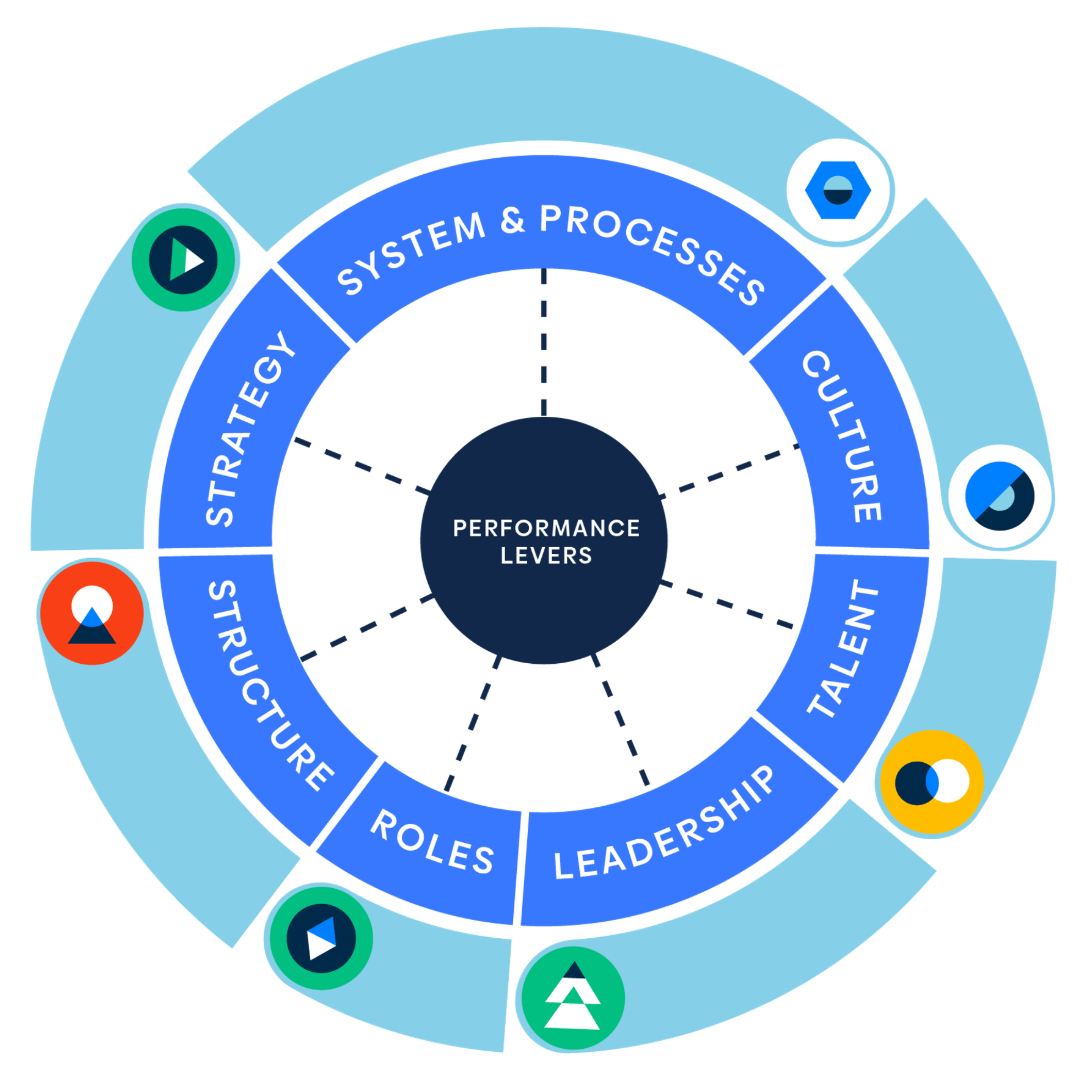
An organization operates like a living system, where various interconnected performance levers—roles, systems, processes, culture, leadership, and talent—all work together. Shifting one lever affects the others. For example, if a company shifts its strategy from serving customers based on geography to focusing on product needs, merely adjusting the organization’s structure in isolation will create a misalignment of talent. Structure alone cannot support this shift. All performance levers must be aligned to work together in harmony.
So where should leaders start? Before focusing on the performance levers, the first step is to define the strategy that will drive the organization’s design. From there, it’s critical to assess your organization’s current design and what needs to change to drive the strategy forward.
To set up your organization for sustainable, long-term success, resist the urge to implement a new org chart from the top down. Instead, adopt a value-based approach to organizational design and implementation, as outlined in this seven-step framework.
Step 1: Define a Clear Vision and Strategy
Clarifying your organization’s vision and business strategy is essential to designing a future-state organization. If your leadership team has already defined and aligned on a vision and strategy, you’re ready to move forward. If not, begin by creating a strategy map that defines:
- The shared vision of a future state. What will be different for customers/clients, and what does that mean for the business and employees?
- The strategy. What are the choices, priorities, and trade-offs that leaders make to move the organization toward its vision?
This process of defining the vision and strategy builds alignment among leaders. And when communicated in a compelling way, it will mobilize the entire organization to move forward together.
Whether you’re shaping a functional or enterprise-wide strategy, aligning on a clear business strategy—such as customer-centered growth, operational efficiency, or product innovation—sets the foundation for a new organizational design. It’s important to engage key decision-making leaders from the start to ensure alignment and ownership throughout the process.
Best practice: Clarity drives execution and results. Be as specific as possible when articulating your strategy. Define the measurable changes that will occur and the timelines (e.g., “We will launch three market-disrupting products by 2030”).
Step 2: Assess Your Organization’s Strengths and Gaps
Once you’ve aligned on your business strategy, the next step is to identify the capabilities your organization needs in order to achieve that future-state vision. Start by answering the question: What do we need to do exceptionally well to execute our strategy?
Next, you need to understand the organization’s current strengths and gaps in relation to those future-state capabilities. This requires a deep dive into your current state to assess where you excel and where improvements are needed. Keep in mind that organizations are like living systems, and the strengths and gaps are interconnected across several performance levers, including roles, processes, culture, structure, leadership, and talent.
As your strategy evolves, each of these levers will be affected by the changes you implement. That’s why assessing the current state of each lever is critical for shaping your future-state organization. The output of this assessment will be a report that provides an objective overview of the organization’s strengths and gaps.
Best practice: Share these findings with key stakeholders early on to prepare the organization for change. Make it clear that realigning the organization goes beyond creating a new org chart. It’s about realigning the entire system to support the strategy.
Step 3: Determine Your Design Objectives and Principles
Building your future-state organization model starts with assembling an all-star design team. This team should include leaders who own key parts of the strategy, subject matter experts, and key influencers who will champion the change and rally others.
When selecting members of this team, balance the need for expertise with the power of informal influence. Because the design process can be somewhat messy, ensure that members can hold discussions in confidence and act in the interest of the organization rather than focusing on personal agendas. Make sure to include any key voices whose perspectives would be valuable in shaping the future state.
Bring the design team together for a series of working sessions. Start by determining your design objectives and success measures. To pinpoint these objectives, ask the question: What do we need the organization’s design to enable in our organization? Consider whether the change is primarily focused on driving innovation, strengthening customer relationships, or increasing efficiency.
From these objectives, you can identify the design principles that will guide the design process. These are the essential “musts” and “must nots” for the design. They might include statements like:
- Must promote integration across teams to prevent silos.
- Must improve the recruitment and retention of talent.
- Must build capabilities to meet the needs of the next 10 years.
- Must drive efficiency and enable us to scale.
Best practice: Design principles ensure your organization’s values are reflected and prevent unintended consequences in the design. For that reason, it’s critical to share these principles with key leaders, gather their input, and ensure alignment.
Step 4: Design the Operating Model and Leadership Structure
Organization design, at its core, is about organizing work in a way that makes the most sense for the strategy you’re seeking to achieve. The operating model serves as the blueprint. It should include governance considerations, high-level business process flows, and ongoing business activity groupings required for each design objective (e.g., client/customer relationship functions, technical and expert functions, and operational functions).
For example, an operating model framework can group activities by the type of value needed to optimize innovation, expertise, and customer experience. Here’s how activities might be organized:
Center of Expertise
Objective: Bring technical expertise, knowledge, and consistency to programs and services.
Activities:
- Provide technical expertise.
- Identify and establish best practices.
- Design and build programs and policies.
Outcomes:
- Enhanced service innovation.
- Proactive response to changing needs.
Shared Services
Objective: Minimize involvement and time spent by other functions on transactional activities.
Activities:
- Deliver transactional and process-driven activities.
- Build and continually improve transactional processes.
- Manage efficient delivery of transactional services.
Outcomes:
- Increased efficiency with decreased cost.
- Improved service quality.
Relationship Management
Objective: Provide exceptional customer experiences.
Activities:
- Provide support to customers and users.
- Act as a key contact to customers and broker services from Centers of Expertise and Shared Services.
- Gather input on customer needs from these groups.
Outcomes:
- Stronger customer relationships.
- Improved client satisfaction.
Building the operating model from these activity groupings ensures maximum impact, efficiency, and employee engagement. The groupings look different depending on your business strategy and org design objectives. The design team will lead the process of defining the operating model through collaborative working sessions.
Once the operating model is in place, you’re ready to build the org’s leadership structure. This should be derived directly from the activity groupings. Typically, a small group of leaders from the function or division, along with the HR function, will lead this process. The broader design team is not involved in this step because they typically have a vested interest in the structure itself.
Begin by presenting two to three leadership structure options that meet the design objectives and reflect the activity groupings. Use a facilitated dialogue to identify the pros and cons of each option, and choose the structure that best supports the business strategy.
At this point, communication and change management become critical. Share the leadership structure with the design team to re-engage them in the process. The way you communicate with the design team will set the tone for how the broader organization will be informed.
Best practice: Incorporate change management and communication practices throughout the organization design process. By doing so, you’ll help prevent resistance to change and ensure quicker alignment and support.
Step 5: Develop Future-State Roles
Once the operating model is designed, bring your subject matter experts and design team back together to develop the future-state roles. Start with the high-level business process flows outlined in your operating model. Then, dig deeper to define the work processes, systems, and roles that drive success in the new structure.
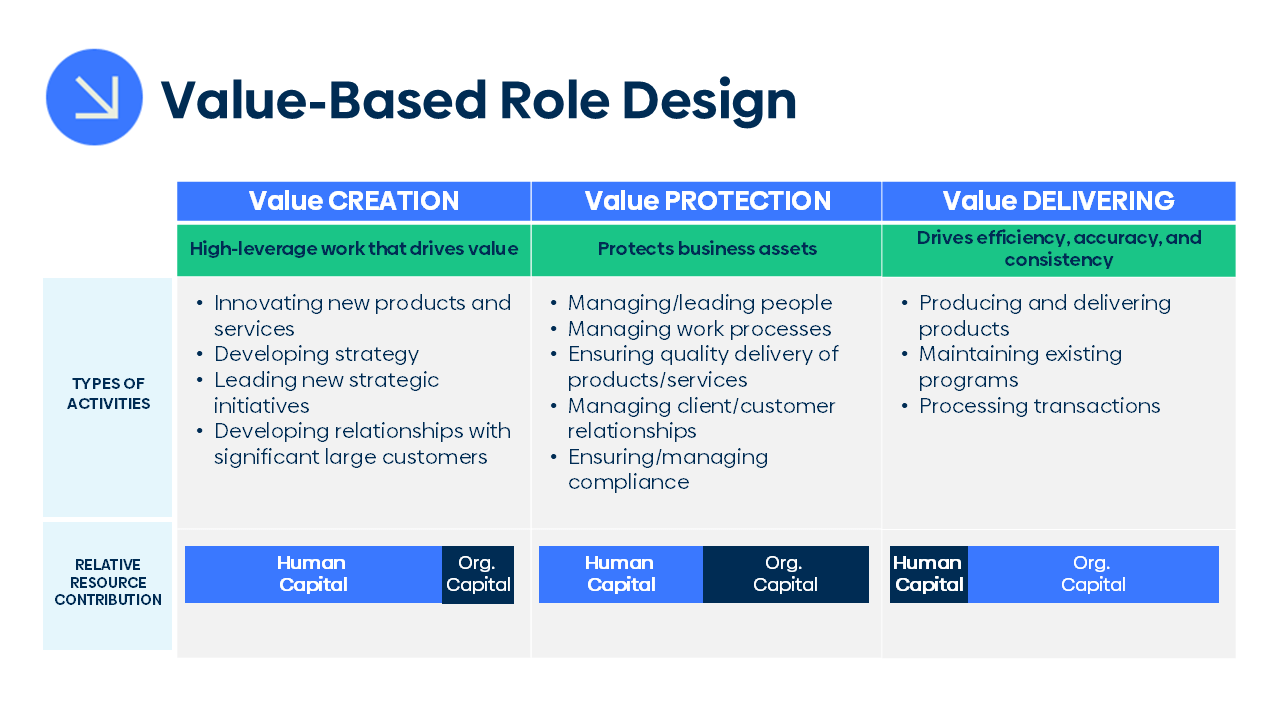
Just as the operating model is built around activity groupings, roles should be designed for maximum productivity and job satisfaction. One effective approach is to align activities based on whether they create, protect, or deliver value. For example, in the image below, the values-based role design framework aligns activities to roles based on whether the activities create value (drive innovation and growth), protect business value (ensure quality and stability), or deliver value (execute business functions).
To craft roles using this values-based framework, create a “responsibility matrix” that defines roles according to their place in work processes. Include design team members and other subject matter experts to ensure accuracy and relevance. Resistance to change often comes to the surface during this role design process. For that reason, engage those closest to the work to foster alignment and ownership.
Before finalizing the new organizational structure and changing roles, host working sessions with executive stakeholders to refine roles and ensure they align with the organization’s goals.
Best practice: A well-designed role should focus primarily on one—or two, at most—of the value types. If a role spans all three categories (value creation, protection, and delivery), it likely includes too many competing responsibilities, limiting the person’s effectiveness.
Step 6: Plan for Implementation
Now that the strategy, structure, processes, systems, and roles are defined, shift your focus to determining your organization’s staffing and talent needs. Start by having HR leadership work with team leaders to determine the number of roles and full-time employees needed to support the new structure. Conduct a workload analysis to properly size the organization based on strategic objectives along with the current and anticipated workloads. Additional talent needs will emerge over time, but this initial assessment provides a strong foundation.
Once your staffing needs are clear, plan for how you will select current talent for new roles and identify roles that require new external talent. For some employees, the shift will be minimal, requiring only slight role adjustments. Others may face significant changes that demand new skills and competencies. A thoughtful, values-driven approach to managing these transitions will be essential.
To guide implementation, create a change plan that includes:
- Identifying impacted groups and when they’ll experience change.
- Anticipating employee concerns and key questions.
- Providing structured support, such as role-based learning, job aids, mentoring, and change ambassadors.
After finalizing the sizing plan, talent selection strategy, and transition plan, share them with key leadership for feedback. From there, refine the plan and prepare to move to full implementation.
Best practice: Consider a co-creation approach to building your implementation, transition, and change plans. Involving employees in the process increases engagement and fosters a two-way dialogue that strengthens buy-in.
Step 7: Activate the New Org Design Plan
The difficulty in implementing your new organizational design will vary based on its complexity, but a structured approach ensures a smooth transition. Keep these tips in mind:
- Launch the leadership team first. Establish alignment and shared ownership. Consider a facilitated offsite where leaders can focus without distractions.
- Roll out changes by level. Announce staffing decisions in a cascading manner based on level. Then move quickly to provide necessary support.
- Align key people practices. Adjust learning programs, rewards, performance management, and career development to reinforce the new design.
- Activate the new org design. Support the transition with change management, clear communication, and ongoing operational support.
Best practice: Building ownership and engagement requires setting people up for success. Ensure your systems and processes are in place before asking employees to take on new work or new ways of working.
Case Study: The 7 Steps in Action
When Knauf Insulation North America (KINA) set an ambitious 10-year strategy aimed at doubling revenue, the global company realized it needed new opportunities for product, market, and customer growth—and it needed to rethink its org structure. KINA partnered with TiER1 to create this seven-step process to transform its organizational design to support this goal.
In Step 1, to shift the strategy focus from running the business to growing the business, KINA created a clear 10-year vision, focusing on customer intimacy as the primary competitive driver.
Next, in Step 2, an assessment of KINA’s current capabilities revealed key gaps that needed to be addressed for growth, including these shifts in mindset:
- Away from creating products and toward providing innovative customer solutions.
- Away from cost management and toward pursuing new revenue opportunities.
- Away from risk avoidance and toward new possibilities.
- Away from viewing failure as unacceptable and toward embracing it as a learning opportunity.
Through assessment, we identified gaps in KINA’s business strategy capabilities, plus several new capabilities to support these mindset shifts. We grouped these capabilities into three themes: customer listening, strategy activation, and business diversification. We embedded sustainability in each capability to ensure long-term success.
In Step 3, we engaged a cross-functional team of senior leaders to establish design objectives related to KINA’s four principles (customer centricity, people engagement, sustainability, and profitable growth).
In Step 4, we designed the future-state operating model. Using the values-based alignment framework, we outlined the anticipated activities to be completed in each business activity (manufacturing, sales, etc.).
In Step 5, we designed future-state roles by function. To enable operating units to focus their energy on growth, we decided that KINA’s supporting functions (HR, finance, IT, legal, etc.) would remain centralized but with customization to support growth.
In Step 6, we developed a road map for implementation, outlining required capabilities, structures, roles, and talent needs.
In Step 7, KINA’s CEO announced the new structure to the organization and the reasons for the change.
What Makes Good Microlearning?
The four key components all microlearning content should have.
 Joe Jahnigen – Sr. Consultant
 Microlearning is a buzz word that has been bouncing around the L&D community for the past five years or so, but what does it mean? Spend a few minutes clicking around the web, and you are likely to find a few common descriptors, including “chunked,” “bite-sized,” “short,” and “mobile-friendly.” While these words are all related to what microlearning can be, they do not accurately describe what microlearning should be.
What Microlearning Should Be
Microlearning is concise, mobile-friendly learning that is chunked into logical parts. More important, however, it is engaging, authentic, easy to access, and driven by choice. Read on for ways to create microlearning content that checks all four of these boxes:
Microlearning is concise and engaging.
High-quality microlearning content needs to be designed from end-to-end with an emphasis on engagement and efficiency. Sixty minutes of boring content condensed down to 20 minutes of boring content is still boring! Utilizing a variety of modalities (such as video, animation with voiceover, podcasts, interactive PDFs, eLearning, infographics, asynchronous collaboration tools, etc.) that are aligned to course objectives provides the learner with an easy-to-follow structure and continuous engagement as they move from section to section.
Microlearning is authentic.
Microlearning that’s authentic and approachable mimics the learning process users call upon outside of work. In the age of DIY and YouTube, employees no longer connect with stuffy, overproduced instructional videos supplied by corporate. Today’s learner is more comfortable learning from YouTube than a manual. Creating content that seamlessly fits into this established pattern leads to higher usage rates and a potentially faster time to competency.
Microlearning is easy to search and access.
To be effective, microlearning content must be easy to search and access. How often do your employees email you asking how to find content instead of searching for it on their own? Good microlearning is easily accessible and intuitively curated and indexed. Job aids, process documents, and templates are designed to be used in the moment of need. Make sure to remove potential barriers to use (such as creating content that’s only available on specific devices or platforms, needing multiple levels of authentication, or burying content under complex navigation) so the learner sees your resource as an easy way to improve their productivity.
Microlearning is driven by choice
Giving the learner a choice allows them to access the information they need in a way that fits into their lifestyle. This choice refers to both the content covered and the modality used. Microlearning should not be dependent on time and place, and offering options in modality gives the user a sense of ownership over their learning. When you are choosing to search for something, boredom becomes less relevant; the need to solve a problem supersedes the level of engagement. Offering learners choices in when, how, and where to consume their content allows them to learn what they want when they need it.
The Challenge of Microlearning
The challenge of microlearning is that it is not a template you can simply push old content through to magically produce high-quality, concise learning material. The creation of the learning content needs to be intentional and designed from end-to-end with these guiding principles in mind. Microlearning is not a trend. It’s a tool to create and deliver just-in-time solutions for performance support that is concise, engaging, authentic, easy to access, and driven by choice.
What’s Possible with Immersive Learning?
Immersive learning and training has been talked about as the future of learning. Let’s explore what’s possible.
 Matt Ciocca – Sr. Consultant
 When it comes to “immersive learning,” are you a believer—or are you a skeptic? Too often, users encounter eLearning modules that are repetitive, disengaging, or tedious. How might you bridge the gap and create learning content that is truly immersive?
At TiER1 I’ve seen how we can create the right experiences when we know where we’re going, the behavior changes we’re supporting, and the desired business results. We build immersive learning experiences by first identifying where we want to take our training. Then, we tailor experiences to the user so that they feel transported to an environment or situation where they can engage at a level that was previously unattainable.
True immersion is achieved by leveraging several technologies and practices that enable the training to make that leap. Let’s dive into some examples of how deeply immersive learning is possible.
Matt Ciocca was joined by Matt Kroeger for a podcast on this topic, which aired at the 2021 eXLearn Virtual Conference, to discuss how to design human-centered experiences for skills practice using simulations and AR/VR. To listen to their conversation, watch the YouTube video.
Creating awareness and empathy
Whether it’s live-action video, motion graphics, or stunning photography, creative assets can be deployed across a range of modalities to create greater awareness and empathy.
For example, we partnered with a healthcare association to design a 3-day certification program built on an innovative Train-the-Trainer model. The solution included print-ready simulation game materials and posters for a variety of settings, as well as video and photo elements from their actual environments, which we used to make the simulations even more immersive.
Designed to elevate the profession, outcomes of the program included lowered infection rates and a cumulative satisfaction score of 99% from participants; the program also was awarded Gold for “Best Results of a Learning Program” and “Best Certification Program” (2018 Brandon Hall Excellence Awards).
Connecting participants with key stories and moments that matter
Another example of immersive learning, we partnered with Lundbeck to improve sales engagement. In their business, large portfolios mean decision points when selling, and if reps don’t feel connected to products, those products can be minimized in the pitch. Instead of training on product knowledge, we connected reps to the people seeking treatment through environmental augmented reality (AR) “triggers” to provide just-in-time support. This both reduced the amount of training information and optimized the learning experience for empathy-building.
For live events, QR codes enabled participants to launch materials as they explored exhibits. To guide their experience, we developed an AR web app; four unique audio-driven patient persona journeys, a post-event chatbot, and follow-up communications. In addition to the live event, we developed a reusable experience for an offline mode to be used for classroom settings or independent learning.
Our goal in highlighting people and their stories, instead of the product, was to help reps better see the humanity and needs being impacted beyond the sales conversation, thus immersing them into a deeper purpose that drove behaviors and results.
Training in choice-driven situations, scenarios, or simulations
Simulation and scenario elements give learners the experience of being a participant in the narrative (instead of a consumer of content). Simulations are ideal for practicing skills higher on Bloom’s Taxonomy of Learning as well as any skills that are difficult or risky to try in the real world. (Think, handling an emergency in a hospital; making business decisions in a time of crisis; managing an in-flight emergency; or high-stakes sales conversations.)
They also don’t have to be complex. As part of a broader curriculum, we developed an interactive eLearning module with live-action video for NxStage to support patient learning on how best to troubleshoot device alarms. Live-action video adds realism to the situation by putting you in the shoes of someone else. Paired with knowledge check questions that add the element of choice plus reinforcement, and the live-action video simulation is a simple yet powerful option.
Onboarding, orienting to, or immersing in a specific context
Fully immersive experiences through virtual reality (VR) take immersion to the next level by providing participants with an interactive environment to try out their skills. These skills can be accomplished through a simulation, branching video, or other design techniques embedded within the VR experience. VR, when done right, is powerful for increasing learner engagement, increasing retention, and reducing speed to proficiency.
The investment into technology is lower than it’s ever been. Google Cardboard headsets are among the most affordable while not sacrificing too much interactivity. If mobility is needed, Oculus and others have released all-in-one VR headsets and input devices without the need for other accessories. Using CenarioVR, we developed an interactive and immersive 360-degree tour of each TiER1 office within a VR setting. This high-fidelity, user-driven experience created meaningful engagement moments for visitors and new team members at TiER1.
The future of learning
Immersive training has been talked about as the future of learning. With innovations in driving story and build skills (ranging from simulations and scenarios to gamified nudges), immersive learning experiences aren’t only relegated to science fiction. We can recreate real-life settings, simulate work challenges, and give our users the chance to take on-the-job training, without risk, without fear. We invite you to explore ways that you might leverage the unique conditions of your situation to weave in elements that will fully immerse users in the learning experience.
To learn more and connect with someone on the TiER1 team about immersive learning, please reach out using the form at the bottom of the page.
Choosing the Right Learning Tech for Your Company
Explore the differences between top learning platforms and tech to decide which best meets your company's needs.
 Steve Owens – Principal
 Transformations often lead to a re-evaluation of the learning experience and associated platforms to support the future needs of the organization. With so many innovative learning platforms available, choosing the right one can feel overwhelming. While a single platform likely won’t meet every learner’s needs, understanding what each type of learning platform does—and how it fits into your broader ecosystem—is essential for maximizing both business value and learner engagement. We break down the main categories of learning platforms, what they offer, and what to consider when selecting a solution.
Learning Management Systems (LMS)
These remain foundational in many organizations. LMS platforms are primarily administrative tools used to manage, deliver, and track formal training—especially compliance-related programs. Admins curate what learners see and track completion, certifications, and progress.
Use Cases: LMSs are essential in compliance-focused or regulated industries where tracking and structured delivery is key. They’re often part of broader Human Capital Management (HCM) platforms but can also stand alone.
Big Players in 2025: Absorb, Cornerstone Galaxy, and Docebo. Among HCMs, Workday, SAP SuccessFactors, and Oracle continue to offer LMS capabilities—though their user experience and flexibility vary.
Learning Experience Platforms (LXP)
LXPs offer a modern, user-centered learning experience that feels more like Netflix than a corporate training portal. These platforms curate content based on AI-driven recommendations, user behavior, and skills interests—allowing users to explore, share, and contribute learning content.
Use Cases: LXPs are ideal for enterprise organizations focused on employee-driven learning, upskilling, and reskilling. LXPs are often layered on top of LMS systems or integrated into broader talent platforms.
Big Players in 2025: Degreed, Cornerstone, Learning Pool, Sana (AI-powered), and emerging players like Learnerbly and Continu. NovoEd deserves a special mention for offering cohort-based, social learning experiences that bridge formal and informal learning.
Integrated Learning Systems (ILS)
ILS platforms blend the structure of an LMS with the personalization of an LXP in a unified interface and reporting engine. Many ILS tools also include content authoring tools, built-in third-party content, and the ability to manage everything from formal compliance to informal learning discovery.
Use Cases: ILSs are well-suited for organizations that need to balance top-down learning requirements with bottom-up learner autonomy.
Big Players in 2025: 360Learning, Fuse Universal, Valamis, and Cornerstone Galaxy. Several LMS and LXP providers are converging into this space, so you can expect more hybrid platforms to emerge.
Content Management Systems (CMS) and Sales Enablement Platforms
While not learning platforms in the traditional sense, these tools play a major role in sales readiness and performance support. They manage content across the sales lifecycle—from content creation and version control to in-the-moment enablement and coaching.
Use Cases: These tools are powerful when aligned with revenue enablement strategies. Look for integrations with CRMs, as well as strong analytics, coaching, and microlearning capabilities.
Big Players in 2025: Allego, Bigtincan, Seismic, and Showpad remain category leaders. Highspot is also gaining momentum with its tight integration of enablement and analytics.
AI in Learning: A Platform or a Power-Up?
As learning technologies evolve, artificial intelligence is becoming both a feature within platforms and, increasingly, an alternative to traditional learning systems.
AI-Enhanced Platforms
Many modern platforms—from LMS to LXP to ILS—are embedding AI to enhance the learner and administrator experience. On the learner side, AI powers personalized recommendations, adaptive learning paths, and intelligent search. For administrators, AI can automate content tagging, generate course descriptions, and surface learning insights through analytics dashboards.
AI as the Platform
In some cases, AI itself is replacing the need for a traditional learning platform. Forward-thinking teams are using generative AI tools—like ChatGPT, Claude, or Microsoft Copilot—to deliver just-in-time, contextual learning without a course or module. These tools act more like smart assistants than structured learning environments.
Use Cases: Instead of building a full onboarding module, some companies embed an AI bot into their systems to answer new hire questions in real-time. Teams use AI chatbots to simulate sales scenarios or coach managers on difficult conversations—no LMS required. Internal knowledge bases are being transformed with AI to allow conversational search, replacing the need for formal eLearning.
Big Players in 2025: Degreed and Sana use AI to recommend learning content based on user profiles and skills data. Docebo offers AI features to auto-tag content and create learning plans. Cornerstone’s tools use generative AI to help authors create learning experiences more efficiently.
This shift doesn’t mean platforms are obsolete—but it does challenge us to think differently about how learning happens. The future of learning might be less about where it’s delivered and more about how intelligently it’s delivered, in the flow of work.
Emerging Platform Types to Watch
As learning technology continues to evolve, so does the variety of platforms available to meet specific learning and performance needs. These emerging or adjacent platform types might not replace your core LMS or LXP, but they can dramatically enhance your ecosystem depending on your business goals.
Skills Platforms & Talent Intelligence Systems
These platforms go beyond course catalogs and focus on identifying, mapping, and developing skills across the organization. Many integrate with learning systems but are designed for workforce agility and internal mobility.
Use Cases: Skills-based learning, talent mobility, and reskilling
Big Players in 2025: Gloat, Eightfold, SkyHive, and Retrain.ai
Cohort-Based & Social Learning Platforms
Designed for structured, group-based learning experiences, these platforms emphasize collaboration, discussion, and shared accountability and are especially valuable for leadership, onboarding, and culture-driven programs.
Use Cases: Leadership development, team-based learning, and DEI training
Big Players in 2025: NovoEd, Circle, Coassemble, Disco, and Butter
Microlearning & Mobile-First Platforms
These platforms prioritize fast, focused learning experiences—often delivered via mobile or embedded in daily tools. Many are built with frontline teams, sales, or time-constrained professionals in mind.
Use Cases: Frontline training, just-in-time reinforcement, and performance support
Big Players in 2025: Axonify, eduMe, EdApp, Spekit, and Qstream
In-the-Flow Learning & Digital Adoption Tools
Rather than taking learners away from their work, these tools embed learning into apps, systems, or workflows. Some combine training with help desk functionality or process automation.
Use Cases: On-demand support, software training, and performance enablement
Big Players in 2025: Whatfix, WalkMe, Pendo, Stonly, and Guru
Choosing the right platform(s) for your organization depends on your learning goals, user needs, technical landscape, and budget. And increasingly, it’s not about picking a single system but rather designing a thoughtful learning ecosystem that connects platforms, people, and purpose.
Is your team trying to decide on the best learning tech mix for your organization? We help teams navigate everything that impacts the learning and performance experience—from platforms to mindsets and everything in between. Reach out in the form below or give us a call at 859-415-1000. We’d love to chat.
Note: This article originally published in the Winter 2022 issue of LTEN Focus on Training Magazine. It has been updated to include relevant 2025 platforms and AI technology.
Moments That Matter in Strategy Activation
Want to activate your transformation strategies through people? Consider meaningful moments.
 Katie Frey – President & COO
 Years ago, a client taught me a valuable lesson: Of all the moments that matter, some of the most memorable ones are created while sharing meals.
This lesson came to life recently as we wrapped up our support for pre- and post-acquisition integration efforts. When you are deeply embedded within multiple lines of business, you become a vital extension of the client’s team—and you want to honor a meaningful relationship and the value you created together.
TiER1 hosted a happy hour for everyone to come together, share in each other’s successes, and celebrate our hard work. As a special surprise, we also donated to a local charitable organization on behalf of each person on the client’s team. It was a wonderful moment that really mattered to the team.
Moments Matter to People
Organizations are constantly evolving, and each organizational change sends ripple effects throughout the workplace. These ripples can be seen through thousands of small changes in people as they do their best to adapt and evolve in their new environment.
To help their people, leaders articulate and refine big concepts, such as vision statements, organizational values, operational principles, and cultural characteristics. Yet, these important concepts don’t mean anything unless they are deeply understood and embedded in the hearts and minds of people.
Employees bring to life the organization’s strategies and vision statements through daily actions and interactions. The through line of work is a series of moments that matter: meaningful experiences that help people as individuals and as teams to reinforce concepts, deepen connections, and even learn new behaviors.
We asked TiER1ers to share their stories of moments that matter in activating transformation strategies through people. Here are some of our favorites.
Cultural Alignment
Laura Hoppa: Our client wanted every employee to feel ownership of their company’s existing values. The size of the organization allowed us to do something a little unconventional: we invited employees to share how they felt about each value, with the promise that their feedback would be taken all the way to the top.
In a series of workshops, each with approximately 20 employees, we reviewed the company’s seven values and asked everyone to share:
- Where do you see this value in action at the company?
- When are you awesome at doing this?
- What does this word mean to you?
- How could you live this value more fully?
- How could our company do better at living out this value?
As employees shared with their peers, everyone aligned to a shared vision of what the values could mean. Throughout each workshop, we kept a running list of themes, repeated insights, and potential organizational blockers to the values. That list was provided to senior leaders of the organization, and employees were invited to join the conversation to provide more insight.
These workshops facilitated numerous meaningful moments for employees to come together as a team, amplify positive habits, address negative ones, and discuss their values. (Love this idea? Hear more from Laura on employee engagement.)
Organizational Change
Molly Winter: Time and again on projects, I’ve seen that change is perceived as meaningful if people believe that the change is leading them to something better, that the effort is worth it, and that the gains outweigh what might be lost.
To create meaningful moments, engage people in a dialogue around not just the change itself, but the reasons behind the change. Help individuals craft more meaning by inviting them to share personal experiences as well as feedback with this change or previous changes. Then, be transparent in how decisions will be made and how their feedback will matter throughout the change.
Also, make space for others to get involved and help lead the change as sponsors, champions, or pilot users. This builds trust and gives individuals purpose, handing back some of the control they may feel they have lost in the process of evolving and adapting to new ways of working. Including others also builds community, which is key to promoting a positive experience for those going through large-scale change.
Finally, don’t forget to celebrate achievements together! Recognize individuals and groups not only for their achievements but also for demonstrating desired behaviors, such as providing feedback, contributing, and giving support.
Supporting New Ways of Working
Mike Divine: When we’re trying to change people’s mindsets and actions or help them adopt new ways of working, I’ve found that what matters most is the stories that people tell themselves. If we can guide and influence those stories, then we can change how they think about their role and their value within the organization.
For example, a software development company recently refreshed their corporate values to include agility. But, their performance management process was too traditional and static to drive their strategy of continuous improvement. They wanted teams to facilitate more conversations around individual and collective performance—not just an annual performance review between managers and their direct reports, but regular feedback from teammates and peers as well.
Their approach to getting everyone on board with the new process? Rather than putting everyone in a single training event to “roll out the change,” they knew going in that it would be more effective to craft multiple, small moments along the journey that allowed people to try out new behaviors.
Changing those stories happens in small, meaningful moments over time—and we can (and should) construct those moments intentionally with the right story in mind. (Read more from Mike on how to create training that people actually want to take.)
People & Relationships
Dustin Shell on caring conversations. The kind of conversation you offer with a team member who is struggling to perform will look and feel very differently if that team member is struggling with a personal issue. I supported two clients in figuring out how they can help their people step into better conversations during pivotal moments; getting those moments right allows everyone to achieve their goals.
Zac Ryland on building trust. There will always be those moments in a project where the unaccounted for happens. (Maybe it’s a new opportunity or perspective that we didn’t have before; maybe it’s a roadblock.) How we handle that need for flexibility makes all the difference going forward. It’s a big moment where trust can be formed or broken.
Grant Simmons on maintaining connections. The methodology and processes we follow will create lots of moments that really matter for clients, because it’s about the connection points between our team and theirs throughout the project.
Staffing a project is a powerful moment; we’re putting together the right team for the job, and the work depends on the team we staff. Project kickoff is another moment that matters, because it aligns everyone’s expectations for what the work is and how it will get done. Checking in throughout the project matters, as does holding a “lessons learned” meeting with the team at the end of the work effort.
Moments that Matter Build Momentum for Transformation
They may seem like small moments, but over time, as your people experience these moments that matter, they can add up to something powerful: shared convictions, meaningful connections, and new habits. Ultimately, the build the momentum for your transformation success.
If you’d like to connect with our team to learn more about moments that matter, give us a call at 859-415-1000 or drop us a line below.
Driving Systems Adoption as Sponsor
Unpacking the critical role that Sponsors play in every system implementation.
 Brandee Fantini – Principal
 Every member of the project team has a role to play in driving change, readying people, and creating the environment for successful implementation. In your role as Sponsor of a system implementation effort, you make or strongly influence budget decisions, sit on the steering committee, and have significant influence on project decisions, including people resourcing. You are involved in creating the business case and ensuring ROI is delivered. What you choose to focus on, what metrics get measured, the questions you ask, and your expectations significantly impact how the project team spends its time and how they think about challenges and solutions.
Your support of the project behind the scenes and visibly to the rest of the organization demonstrates your keen interest in helping the project team succeed. You work closely with the Project Lead and other key project leaders to closely monitor project risks. You help make decisions when there are dissenting viewpoints and mitigate issues that get in the way.
Value of change management for Sponsors
If you don’t already have a close working relationship with your Change Lead, start building one. Many a challenge has been discussed, root cause identified and swift path to resolution formed through conversation between the change lead and the sponsor. Connect with your change team in a way that feels authentic and comfortable to you.
The change team is your ear to the ground across the organization. Odds are good that they understand aspects of your business that you don’t fully understand (that’s normal and perfectly okay). When the change team is external, generally the understanding is even greater because it’s easier to ask questions, dig deep, spot trends, and see impacts to project and people readiness. If you’re getting all your information from PowerPoints, meetings, and the Project Lead, broaden your sources for heightened awareness and a wider perspective.
The change team also serves to provide you with concise, targeted communication tools to leverage in advocating for project goals, creating awareness, mitigating barriers, addressing resistance, and leading change.
Your role in driving change
1. Change management is a critical driver of ROI and overall project success—don’t let change, communication, and training budgets get cut or minimized. You invest in people because they are a critical factor in the success of any systems implementation.
2. Be THE change leader. Your role in leading (and driving) change is significant. Employees want to do what makes them successful in their roles, and you define what success looks like. You also have the power to define the criteria that drives change and adoption. Look for opportunities to share your vision for the future, address the tradeoffs that are required to attain the vision, and work to remove barriers to success.
3. There’s a fine line between inspiring others to high performance and asking for more than people can deliver, causing them to disengage. Setting clear priorities that aren’t competing with one another will enable your teams to be successful. When priorities are competing, adjust outcome and timeline expectations so that no one is asked for more than they can feasibly deliver.
4. Resourcing is a critical enabler of systems implementation projects. It’s vital to understand resourcing models and implications, so that you can go to bat for more resources when needed—or set expectations with executives and others that outcomes will be different than expected if resourcing needs aren’t met.
5. Timelines and budgets are difficult to pinpoint before doing the work. Buffered timelines and contingency budget planning enable teams to adapt to change (because the unforeseeable inevitably happens). You cannot know today what obstacles and circumstances will arise to require additional time and funding, but they WILL arise. Prepare for and expect them.
6. Network extensively within the project team, doing skip-level discussions with various workstreams, levels, and roles. Work closely with the business to prepare them for the change. Listen intently to their concerns and time/resource constraints and do what’s necessary for them to succeed. For significant change efforts, delay or relax other initiatives where possible to enable everyone to put their focus, attention, and priority on Go Live.
7. Empower your change team. Ask about people readiness, include it on scorecards, expect your change lead at every steering committee meeting, and mitigate people risks with as much energy and diligence as process or system risks. Set the tone for camaraderie and teamwork across implementation, change, and other third-party partners.
In addition to your role as Sponsor, there are several key roles in the project team AND the change management team for driving change and systems adoption. To learn more, check out our insights on:
- The Value of Driving Systems Adoption Across Roles
- Driving Systems Adoption as the Business Stakeholder
- Driving Systems Adoption as the End User
- Driving Systems Adoption as the Process/Application Developer
- Driving Systems Adoption as the Project Manager
- Driving Systems Adoption as the Project Lead
If you’d like to connect with our team to learn more about driving systems adoption, give us a call at 859-415-1000 or reach out through the form below.
Driving Systems Adoption as Project Lead
Tips for project leads managing relationships with their implementation, software, and change management partners.
Brandee Fantini – Principal Every member of the project team has a role to play in driving change, readying people, and creating the environment for successful implementation. In your role as project lead, you have a lot on your plate: delivering a solution that works, budget and time constraints, the engagement and wellness of the project team, engaging the business, adapting plans to new requirements and constraints, and keeping executives in the loop. You have overall responsibility for managing relationships with your implementation, software, and change management partners. Doing so well means creating a cohesive team across multiple functions and lines of business.
Dan Clark, Oracle Project Lead, PPG Industries, Inc., provides this guidance:
“When issues arise, escalate early and often. Don’t have more than a couple of meetings on any subject because spinning on decisions wastes time and money. Make a decision and move on.”
Value of change management to project leads
It might be misleading to say that all these responsibilities are easier with an experienced change management team leading people readiness for your system implementation. But it is completely fair to say that your effectiveness in driving these outcomes is greatly enhanced by engaging an experienced change team to help you:
- Build a trust-based, cohesive team that works together effectively and efficiently.
- Drive engagement of the project team and mitigate issues or overwork risks (knowing when to adjust timeline, request more resources, reduce scope, etc.).
- Identify and address issues with the solution and/or system by working closely with future end users who know what will and won’t work.
- Organize and facilitate team-building activities to build trust, engagement, and commitment.
- Work directly with super users, leaders, and future end users at sites and business units to prepare them for upcoming changes (at a much more granular level than you’d be able to reach without them).
- Understand and mitigate prioritization issues that come from executive leaders asking frontline leaders to deliver results that conflict with your project resourcing needs.
- Balance competing demands on super user and workstream/process leaders’ time to ensure system and people readiness are both adequately resourced.
Your role in driving change
Bring the change lead into the inner circle. Most project teams establish a senior leadership team (either formally or informally), including the project lead, project manager, solution architect, and a few others. Invite your change lead to be part of that group so they can hear about what’s on your mind, upcoming activities and events, and risks and challenges. It’s also critical to hear first-hand from the change lead what’s happening on the ground with soon-to-be end users and the project team. This helps keep everyone rowing in the same direction.
Other tips:
- Invest in team and individual development. Enable your change team to drive these efforts.
- Listen deeply and intently to all constituents—not to immediately react, but to hear themes and identify complex issues that might not be readily evident.
- Work closely with the change team to size and scope the super user network appropriately based on geography, number of end users, level of change, and function. Help convince other leaders that intense super user involvement is one of the most important factors in successfully going live without negative impact on the business or customers.
- Engage the change team to monitor, track, and report on super user engagement throughout the project. Many times, super users are set up for failure because they aren’t given adequate time and support by their direct managers. Your change team will see those problems before anyone else does, but they need your support to mitigate them.
- Help project team members choose the right “battles” and see when to dig into an issue and when to let one go.
- Engage the business (whomever the change will be impacting). Spend time with them to understand their priorities, how they measure those
- priorities, what obstacles they might encounter in supporting the implementation, and what business challenges they need to solve.
Inspire and motivate others to high performance. Expect a lot, give a lot of yourself, and hold others accountable in a way that encourages engagement and excellence.
In addition to your role as project lead, there are several key roles in the project team AND the change management team for driving change and systems adoption. To learn more, check out our insights on:
- The Value of Driving Systems Adoption Across Roles
- Driving Systems Adoption as the Business Stakeholder
- Driving Systems Adoption as the End User
- Driving Systems Adoption as the Process/Application Developer
- Driving Systems Adoption as the Project Manager
- Driving Systems Adoption as the Sponsor
If you’d like to connect with our team to learn more about driving systems adoption, give us a call at 859-415-1000 or reach out through the form below.
Driving Systems Adoption as Project Manager
Project managers are responsible for balancing system and people readiness. Here are tips to help you prioritize both.
Brandee Fantini – Principal Every member of the project team has a role to play in driving change, readying people, and creating the environment for successful implementation. In your role as project manager, you oversee all aspects of the system implementation, with goals related to budget, timeline, and quality. You might work with other project managers from the change team, workstreams, or IT, and you’re responsible for integrating and coordinating all timelines and milestones. You work closely with the project lead (and others) to define governance, ways of working, reporting, and communication. You’re often creating status reports and explanation materials for the steering committee and other executives, including gathering input, information, and slides from others.
On large projects, multiple project managers representing different functions are often working closely together to ensure a successful implementation. You forecast resource needs and constraints and work with the project team, the business, IT, and executives to remediate issues and risks. You set priorities for the team, often balancing competing tasks and deadlines. You’re responsible for leading an effective team, delivering a quality solution, and enabling end users to successfully adopt the new system and processes.
“I’ve worked with some great project managers,” says John Patton, change management specialist. “The best are the ones who do two things: 1) they see people knowing what to do, why to do it, when to do it, and how to do it as critical as the core functionality of the system they are delivering, and 2) they view the change management team as experts in people just as a developer is an expert in code and configuring. The worst are the ones that only ask for a quick update, ‘Did you send an email to everybody? Did you complete the training?’ Be like the first.”
Value of change management to project managers
A key benefit for project managers when partnering with a strong change team is that, while the change team isn’t the tech or process expert, they are the people readiness expert. Risk is inherent in any large system implementation, and your change team plays a significant role in identifying and mitigating a host of risks before, during, and after Go Live. From process and workflow to system design, the change team is well positioned to understand risks and work with project team members, the business, and leaders to identify and implement solutions for people readiness.
An effective change team creates materials that communicate complexity in a simple, straightforward way. This helps with all aspects of communication, particularly executive leadership communication. Engage your change team in the process of gaining executive support for decisions and resource requests.
Project managers generally do a really good job communicating operational, status, and logistics information to the project team. Engage your change team to take your communications to the next level by creating a strong sense of team, keeping everyone informed, and making the project fun.
When your change team is deeply embedded in your project team, they are often working more closely with end users prior to Go Live than anyone else. This enables the change team to actively and effectively drive business engagement, which is critical to Go Live success. Ultimately, an effective change team can help you deliver ROI from adoption and project success.
Your role in driving change
The project manager’s role in driving adoption is critical to overall project success. Part of your role is balancing system AND people readiness; you must help prioritize both. The critical path isn’t getting to Go Live—it’s ensuring people are able to use a working system effectively at and well after Go Live.
Here are some key tips for your role:
- You have your finger on the pulse of the project, key events, activities, issues, concerns, celebrations, and more. Invite your change team to those meetings and keep them informed of what’s happening. This will enable the change team to be a positive and driving influence across the project team and the business.
- Particularly for large-scale projects, there’s often more than one project manager. If you’re the overall project manager, your role likely includes consolidating various project plans and ensuring dates line up, milestones are appropriately mapped, and events are sequenced appropriately. A key aspect of alignment is accurately forecasting resource needs across the project, as well as planning for additional resources during peak periods of need to ensure adequate support for system and people readiness tasks.
- Set the standard for sharing information, explaining decision rationale, and trusting the team. Invite the team to share challenges and risks. Work closely with the project lead to create an engaged, highly functional, and accountable team.
In addition to your role as project manager, there are several key roles in the project team AND the change management team for driving change and systems adoption. To learn more, check out our insights on:
- The Value of Driving Systems Adoption Across Roles
- Driving Systems Adoption as the Business Stakeholder
- Driving Systems Adoption as the End User
- Driving Systems Adoption as the Process/Application Developer
- Driving Systems Adoption as the Project Lead
- Driving Systems Adoption as the Sponsor
If you’d like to connect with our team to learn more about driving systems adoption, give us a call at 859-415-1000 or reach out through the form below.
The Value of Driving Systems Adoption
How learning a new skill can bring teams together.
Brandee Fantini – Principal A critical component of every successful system implementation is people readiness, usually driven by an effective change management team. Too often, though, the focus is largely on system readiness, and people readiness can sometimes take a backseat when it comes to funding, prioritization, and even understanding its value.
Far from being the “soft stuff,” people readiness can and should be defined, managed, driven, and measured. It belongs on the project scorecard, in every project update, and as a topic in every steering committee meeting. At TiER1, we believe investment in people is THE critical success factor in system implementations.
After all, it’s people who:
- Gather requirements from other people.
- Design and build the system.
- Map processes and define new ones.
- Test and configure the system.
- Validate functionality.
- Migrate data.
- Help other people learn what’s changing.
- Train others on how to use the system.
- Identify and mitigate risks.
- Troubleshoot and problem-solve at Go Live.
Every member of the project team has a role to play in driving change, readying people, and creating the environment for successful implementation. Let’s take a quick look at some key roles in the project team AND the change management team, and how those roles can work together most effectively to drive change.
Dan Clark, Oracle Project Lead, PPG Industries, Inc., provides this guidance: “When issues arise, escalate early and often. Don’t have more than a couple of meetings on any subject because spinning on decisions wastes time and money. Make a decision and move on.”
Project Lead
In your role as Project Lead, you have a lot on your plate: delivering a solution that works, budget and time constraints, the engagement and wellness of the project team, engaging the business, adapting plans to new requirements and constraints, and keeping executives in the loop. It might be misleading to say that all these responsibilities are easier with an experienced change management team leading people readiness for your system implementation. But it is completely fair to say that your effectiveness in driving business outcomes is greatly enhanced by engaging an experienced change team to support you.
Check out these tips to learn more about the Project Lead’s role in driving change.
Project Manager
In your role as Project Manager, you oversee all aspects of the system implementation, with goals related to budget, timeline, and quality, and you’re responsible for integrating and coordinating all timelines and milestones. A key benefit for Project Managers when partnering with a strong change team is that, while the change team isn’t the tech or process expert, they are the people readiness expert. Risk is inherent in any large system implementation, and your change team plays a significant role in identifying and mitigating a host of risks before, during, and after Go Live. From process and workflow to system design, the change team is well positioned to understand risks and work with project team members, the business, and leaders to identify and implement solutions for people readiness.
To learn more about the Project Manager’s role in driving change, check out this article.
“I’ve worked with some great project managers,” says John Patton, Change Management Specialist. “The best are the ones who do two things: 1) they see people knowing what to do, why to do it, when to do it, and how to do it as critical as the core functionality of the system they are delivering, and 2) they view the change management team as experts in people just as a developer is an expert in code and configuring. The worst are the ones that only ask for a quick update, ‘Did you send an email to everybody? Did you complete the training?’ Be like the first.”
Sponsor
As Sponsor of a system implementation effort, you make or strongly influence budget decisions, sit on the steering committee, and have significant influence on project decisions, including people resourcing. The change team is your ear to the ground across the organization. Odds are good that they understand aspects of your business that you don’t fully understand (that’s normal and perfectly okay).
When the change team is external, generally the understanding is even greater because it’s easier to ask questions, dig deep, spot trends, and see impacts to project and people readiness. If you’re getting all your information from PowerPoints, meetings, and the Project Lead, broaden your sources for heightened awareness and a wider perspective.
Check out these tips to learn more about the Sponsor’s role in driving change.
Business Stakeholder
Depending on what type of system is being implemented, you could be the primary sponsor or one of many who will be adopting the new system and related processes. You’re also juggling competing priorities to meet the objectives of your department/site/function while simultaneously supporting the project.
Change management is critical for minimizing risk to your post-Go-Live productivity and ability to meet internal and external demands. There will be times that the change team will ask for access or time from some of your most critical team members. The concept of “pay now or pay later” is super relevant to you. It’s hard to justify shifting people’s time and focus to something that could happen years from now (Go Live). In our experience, though, most business sponsors wish they had dedicated more upfront resources to people readiness once they get past Go Live, when lack of preparedness is most obvious and incredibly challenging to address quickly.
To learn more about the Business Stakeholder’s role in driving change, check out this article.
Application/Process Developer
As a developer, your focus is the system, processes, and making it all work as expected for end users and business leaders. You might not be directly involved with people readiness strategies and activities, but you play a significant role in both. Change management is valuable to you because it drives adoption of the process improvement you poured blood, sweat, and tears into creating.
Check out these tips to learn more about the Developer’s role in driving change.
“The change team understands some of the critical tips and tips for better user adoption. Efficiency often lies in a few small details that allow the business to achieve the desired results,” says Doug Whiting, Global SAP Practice at DXC.
End User
Of all the roles in a system implementation, yours is arguably the most important. If and how you choose to use the system and adopt new business processes will make or break a successful Go Live.
Change management is your champion—they are your advocate in all things, and they often act as the voice of the end user to the project team, sponsors, and business stakeholders. That doesn’t mean change will be easy or that some roles/individuals won’t have more system clicks or different responsibilities than before. But it does mean having a team dedicated to your success every step of the way.
To learn more about the End User’s unique role in driving change, check out this article.
Tips for managing tensions across roles
1. Tension will inevitably arise regarding which critical path tasks are most important at any given time.
Work with other project leaders to ensure a healthy balance between system readiness tasks (such as testing) and people readiness tasks (such as documenting and communicating change impacts).
Roles impacted: Project Lead, Project Manager, Sponsor
2. Gaining support for adequate project, SME (subject matter expert) and Super User resources is not easy.
It can be incredibly uncomfortable and time-consuming persuading senior and front-line leaders that resource investment is needed. The business is usually under pressure to deliver different outcomes, making it challenging to focus on people readiness early in the process. However, implementing a new system requires a resource lift, and there comes a point where that lift can’t come from the existing team alone. Early involvement from Super Users is critical to long-term success (and a smooth Go Live). Extra resources (contract, part-time, etc.) are often needed to backfill existing team members and get through a Go Live successfully. Project leaders can support End Users and Business Stakeholders by gaining approval for additional resources and creating time and space for Super Users to engage in a meaningful way.
Roles impacted: Project Lead, Project Manager, Sponsor, Business Stakeholder
3. Balancing deadlines and project team health can feel like walking a tightrope at times.
Timeline delays mean budget impacts, but the health and well-being of the team is critical. Short-term pushes are often needed, but you can’t let your team members burn out. Balance motivating and inspiring the team to high performance with knowing when team members are overwhelmed, pushing too hard, getting sick, or burning out.
Roles impacted: Project Lead, Project Manager, Sponsor
4. When it comes time to Go Live, you lead the team in making the call on whether you’re ready—or not.
Delaying Go Live is a big and unpopular decision. A lot of factors need to be weighed, and all major stakeholders need to share their perspective on “go or no go.” If the risk to business continuity is too great, have the confidence and influence to help others understand a “no go” decision. Defining “go” criteria early in the project and making that decision multiple times leading up to cutover, can help tremendously.
Roles impacted: Project Lead, Project Manager, Sponsor
5. Tensions between system and people readiness are inevitable and healthy.
It helps to be balanced in prioritizing. Great people with a positive mindset can often make a bad system work, but rarely will people make a system work when they don’t want it to work.
Roles Impacted: All
6. There will come a time when you need to make a decision about quality versus timeline/budget.
Don’t let perfect get in the way of moving forward. However, don’t sacrifice business continuity and trust in the project team by pushing forward when the right answer is to take more time to do it right.
Roles impacted: Project Lead, Project Manager, Sponsor
Like these insights and want to read more? Check out the following insights on:
- Driving Systems Adoption as the Business Stakeholder
- Driving Systems Adoption as the End User
- Driving Systems Adoption as the Process/Application Developer
- Driving Systems Adoption as the Project Manager
- Driving Systems Adoption as the Project Lead
- Driving Systems Adoption as the Sponsor
If you’d like to connect with our team to learn more about driving systems adoption across roles, give us a call at 859-415-1000 or reach out through the form below.