
 Mike Lewis
 Don’t view this in a critical way, but understand most people were never shown how to work with these tools effectively.
Here’s what we’ve seen consistently at TiER1: Someone opens ChatGPT, Gemini, Copilot, or Claude; types a request; gets a response and thinks, Meh. Impressive tech, but it can’t really do what I do. And then goes back to doing everything manually.
Meanwhile, someone down the hall is using the same tool to produce work that’s indistinguishable from their best thinking. It’s the same technology, but with a completely different result.
Generative AI predicts what comes next based on what you give it. Therefore, thin input leads to thin output. But when you pour in real context and let AI push back with questions and ideas of its own, something shifts. The output starts to feel like it came from you. Because in a sense, it did. You just had a thinking partner that helped get you there faster.
That’s what our Five-Step Prompting Process does. It’s a workflow for curating context so AI can give what you need more effectively. It’s not a robot doing your job, but more like a synthetic teammate that’s augmenting your thinking.
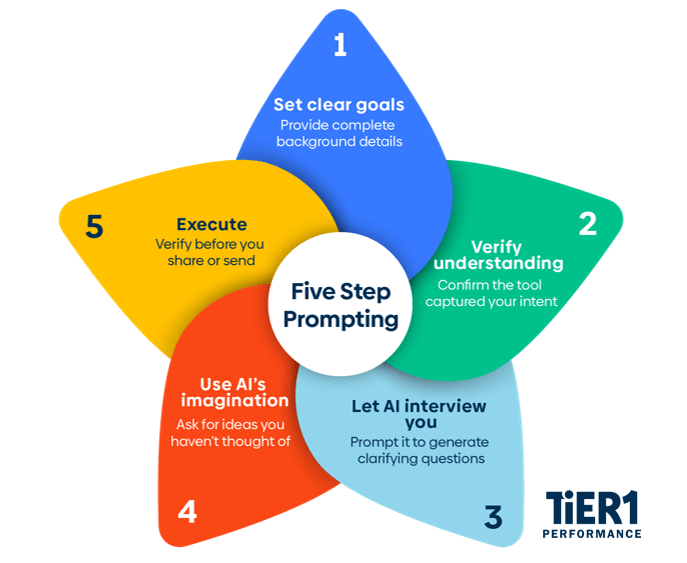
You don’t need to take all five steps for every interaction, but you want these reflexive habits on tap when the stakes are high (like landing a major account or a six-month deliverable) and for work that actually moves the needle.
We used step three while writing in this article. It wasn’t high-stakes, but the habit was there.
These Five Steps are part of 25 super user habits we teach at TiER1. They work across platforms (ChatGPT, Claude, Gemini, Copilot, Grok), roles, and industries. This is how we’re equipping people for the future of work. And, honestly, it’s working better than we expected.
Fill out the form below and someone from our team will contact you.