
 Elise Cappella and Joanne Carretto – Senior Solutions Consultant and Principal Consultant, respectively
Ahead of the 100th anniversary of the global company Knauf in 2032, Knauf Insulation North America (KINA) set an ambitious 10-year strategy aimed at doubling its revenue. The global manufacturer’s executive leadership sought to grow through new channels, markets, and product lines while remaining true to its core values of entrepreneurship, partnership, commitment, and humanity. Leaders recognized that these growth strategies would require building new capabilities and re-organizing the business.
“We have a tremendous history of success at Knauf, built on entrepreneurial spirit, strong relationships, and people who are deeply committed to this business. But we recognized that the very things that made us successful weren’t necessarily going to take us where we wanted to go next,” says Gina Max, Senior Vice President and Chief Human Resources Officer at KINA. “Doubling the business requires us to think differently about how we’re organized, how we make decisions, and the capabilities we need for the future. We weren’t looking to change who we are. We were looking to build on what makes us great.”
In March 2023, KINA began partnering with TiER1 Performance to redesign its operating model as well as its organizational structure. Together, we assessed current capabilities, aligned leadership on strategic priorities, and designed a scalable operating model and future-state roles that would support sustained growth while preserving customer satisfaction, employee engagement, and alignment with core values. The partnership has since evolved to ensure specific functions are structured to support KINA’s continued growth, including a concentrated effort to build a more modern and integrated Supply Chain organization.
To evolve the enterprise’s strategic focus from running the business to growing the business, KINA needed to shift from a successful history of prioritizing operational excellence to also embracing customer intimacy as a primary competitive driver. KINA’s leadership understood that the capabilities and mindsets that enabled past success also needed to evolve to support the new growth strategy.
To understand the enterprise’s strengths and areas for growth, we conducted a thorough assessment, which revealed several new capabilities KINA would need to strengthen, including customer listening, strategy activation, and business diversification. These new capabilities would support the following mindset shifts, enabling the organization to increase its focus on customer intimacy:
Based on insights from the assessment and alongside a cross-functional team of senior leaders, we partnered to:
After prototyping, testing, and refining the new structures, processes, and roles, we developed a roadmap for implementation that also outlined key culture and talent needs. While this initial design phase spanned about six months, KINA and TiER1’s partnership evolved to support the implementation of the operating model in some key areas. Most recently, TiER1 supported KINA’s Supply Chain optimization effort.
“One thing I’ve always valued about our partnership with TiER1 is that they understand our business, culture, and people. We’ve done a lot of important work together over the years, and there’s a level of trust that allows us to have tough conversations and challenge our thinking,” Max says. “Starting at the enterprise level was critical because we needed to understand how all the pieces fit together before we started redesigning individual functions. That foundation has enabled us to be more intentional about the changes we’re making, including the work we’re now doing in Supply Chain. It’s not a series of disconnected initiatives. It’s about building an organization that can grow and succeed over the long term.”
When Kevin McHugh stepped into his role leading Manufacturing and Operations, including the Supply Chain organization, he recognized an opportunity to intentionally strengthen Supply Chain in support of the enterprise’s growth strategy.
To understand where the Supply Chain organization stood, we conducted a comprehensive assessment, primarily focused on the planning, procurement, and distribution functions, with manufacturing and order fulfillment represented and actively participating in the process. It began with a fundamental visioning exercise that asked leadership a simple but pointed question: why now?
“We have really good people at Knauf who know this business inside and out and will do whatever it takes to deliver for our customers,” says Kevin McHugh. “When I stepped into this role, it became clear to me that we were relying too much on those people to overcome challenges in the way we operated. That’s not sustainable, and it’s certainly not how we’re going to double the size of this business. I didn’t want to keep making incremental improvements around the edges. It was time to take a hard look at the whole system and make real changes.”
Once leaders aligned on why Supply Chain needed to change, we gathered diverse perspectives to gain a clearer picture of its current state. We interviewed leaders within Supply Chain and partner functions; hosted deep-dive sessions with Supply Chain teams to understand day-to-day realities; and reviewed existing job descriptions, org structures, and process documentation. We also benchmarked KINA’s Supply Chain against industry competitors to explore alternative organizing models for consideration.
The assessment revealed several strengths that created early momentum on which to continue building:
The assessment also revealed opportunities to build more connected, integrated ways of working across Supply Chain that would improve performance and align the organization to the enterprise growth strategy. Those opportunities led to the following recommendations:
KINA’s Leaders, including McHugh and Max, agreed with these recommendations, recognizing the long-term value of taking a holistic systems approach to transforming Supply Chain.
To position Supply Chain as a growth enabler, we built a future-state operating model that integrates all functional structures, processes, and roles that impact Supply Chain into a sequence that flows from identification of customer needs through product delivery. We then developed a comprehensive redesign of structure, processes, roles, and leadership across four functions, including planning, procurement, distribution, and supply chain excellence.
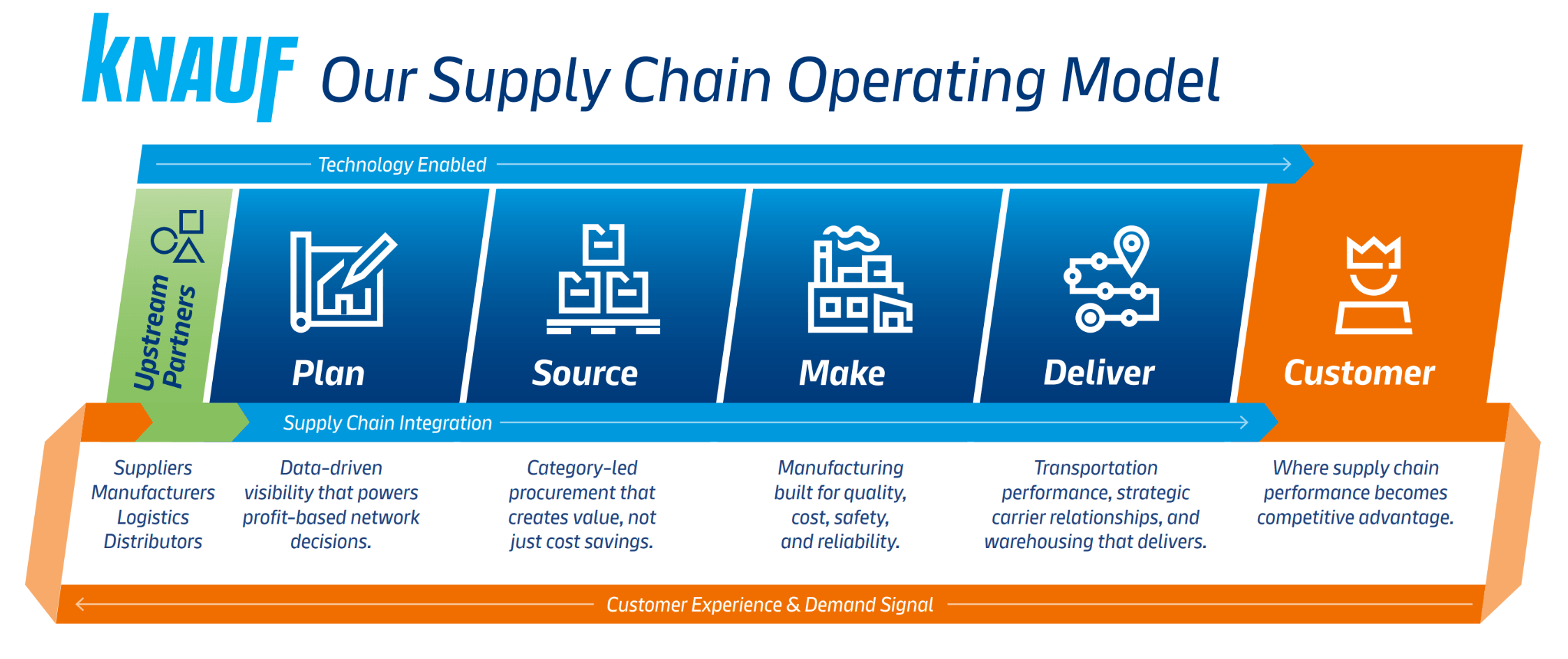
To ensure these changes would stick, we identified new capabilities and ways of working that would shift Supply Chain from a “problem-reacting” mindset, where workarounds and last-minute fixes are the norm, to an “outcome-creating” system, where disciplined processes and shared accountability enable the full system to operate and grow sustainably. To fuel this mindset shift, McHugh recognized the need for a group of “big leaders” who would bring both the technical expertise and leadership depth needed to confidently lead all four Supply Chain functions. So, after defining the new leadership roles and competencies required, we supported McHugh and Max through a rigorous selection process and facilitated launch sessions to align the new leadership team around a shared purpose and consistent ways of working.
With new leaders in place across the four functions, we then aligned each function’s structure to the Supply Chain operating model. We conducted cross-functional working sessions with subject matter experts from all core and partner functions, mapping future-state processes, identifying process improvements, and clarifying roles and decision rights along the way. Rather than prioritize a handful of critical high-level processes, leaders intentionally chose to redesign processes across the four scoped functions. This work culminated with the creation of an improvement roadmap that addresses all aspects required to fully transform Supply Chain, including governance, process, roles and responsibilities, technology, data, and ways of working.
From there, we defined each of the functional structures with management levels and future-state roles. Working collaboratively with Supply Chain leadership, we also built an implementation plan to bring the new organization design to life. This included selecting and transitioning people into new roles and supporting these shifts with people-centered change management. All four functions now have the structure, roles, and leadership needed to operate as a modern, integrated supply chain.
What made this transformation possible wasn’t just the design but also the discipline behind it. KINA’s leaders didn’t hesitate to commit to the deeper work required to transform Supply Chain’s core functions. The structural design work drew on deep internal expertise, and every function was intentionally considered (even those that weren’t within scope to redesign) as part of one connected system rather than in isolation.
“I’m really proud of what we’ve accomplished together,” McHugh says. “We took on something big, and we didn’t shy away from the tough decisions or hard work that needed to happen. What matters most to me is that we’re building something that will last—a stronger team, better ways of working, and a supply chain that can support where Knauf wants to go. This has been a milestone for me personally, and TiER1 has been a great partner in helping us get here.”
As KINA and TiER1 continue to position the enterprise to meet its growth goals before Knauf’s centennial in 2032, the partners are exploring what’s next, including evolving governance to align with the new operating model and providing role and skills training for the teams stepping into the future-state model.
Exploring how to optimize your organization’s structure, leadership, and roles to drive strategic outcomes? We’d love to chat. Drop us a line in the form at the bottom of this page.