Mergers & Acquisitions

Maximize the People Impact in Acquisitions
Thinking about starting the acquisition process? Here are some things to consider.
 Greg Harmeyer – Co-Founder, TiER1 Impact CEO and Board Chair
 Most acquisitions fail to achieve the original financial objectives that were anticipated. Research shows one top reason is that parent organizations fail to fully integrate, activate, and engage the people and culture of the acquired firm.
Getting the “people” side of acquisitions right is essential, though. In today’s world, service is a significant part of almost every business, and people are more transient in jobs than ever before. It’s tough to deliver your brand promise and retain top performers during an acquisition, but the alternative of not doing it isn’t pretty.
If your organization is considering an acquisition, here are some key things to consider:
Get aligned. Regardless of the nature of the transaction, it’s essential to align cultures and values—and that means aligning people. We all process words through our own filters; just because people say the same words doesn’t mean they have the same understanding. Ensure company leaders rally around a common mission and vision by bringing leaders from both organizations together in a facilitated alignment process.
Stay focused. Employees look first to leaders for guidance, motivation, and focus. This is particularly true during times of organizational transition and disruption. Leaders need to be visible, aligned on message, and armed with the knowledge and tools to address concerns. Create a toolkit for your managers and leaders to use in addressing concerns and answering questions.
Address questions. It’s critical (some would say necessary) to include clear and compelling communication throughout the transaction lifecycle. As quickly as possible, communication needs to start by addressing three essential employee questions:
- Do I still have a job?
- What’s my pay and total compensation/rewards?
- Who is my manager?
Be transparent. Fully engaging the acquired company requires creation of trust. Trust doesn’t happen overnight—you need to eliminate reasons for people to be skeptical. It starts with transparency. Share as much as you can as early as you can.
Control the story. People can handle good and bad news, but no news is an issue. With limited information, they will “write their own story.” Tell them the vision, strategy, and timelines and share information regularly.
Anticipate change. If there are process and system integration efforts (and often there are), don’t forget to plan for the changes to come, using tools such as impact analysis, internal marketing, training, and adoption measures.
The bottom line: People matter.
In any acquisition, the desired deal outcome rests to a surprisingly large degree on how well employees are supported and integrated throughout the transaction process. Managing the people side of acquisitions inside both affected organizations is vital—from the day the deal is announced through close and well beyond.

Automate Attendance Management
Automated check-ins. Real-time LMS completions. Better reporting.
Tech that Works for You
Ready to eliminate error-prone spreadsheets and paper sign-in forms? rapidRoster is a cloud-based Automated Roster Management application that effectively captures and records registration, attendance, duration, and completion for classroom, remote, and on-the-job training.

Increase Accuracy
Use barcodes, magnetic swipes, and proximity scanning devices to capture and record accurate data.

Enhance Efficiency
Harness web services technology to automate and accelerate tedious, high-volume data processes.

Integrate Seamlessly
Electronically submit and access data through your Learning Management System (LMS) in real time.

Record on the Fly
Capture ad hoc trainings transcripts to track impromptu, on-the-job learning experiences.

Compare
Below are side-by-side comparisons of using rapidRoster and a modern LMS to record an ad hoc training transcript entry.

Simplify
A simple user interface for instructors and registrars makes it easy to deploy and train users.

Imagine
Instructors and registrars across your organization will be able to quickly and efficiently record thousands of ad hoc transcript entries. The labor cost alone pays for the application.
Easy. Accurate. Real-time.
rapidRoster eliminates the use of manual sign-in sheets, automates the check-in and check-out process for events, and can be integrated with your company’s LMS to electronically capture, submit, and store easily viewable rosters in real-time.
Main features:
- Simple to use
- Access via a PC or tablet
- Utilizes all standard browsers on desktop, laptop, and tablet devices
- Real-time communication with your LMS
- Mark attendance and completion by scanning a badge during check-in/checkout processes
- Option for ad hoc transcripts—perfect for walk-ins and ad hoc training sessions
- Learner quick search
- Mark class complete with a single click
- Cancel registrations
- Export roster as CSV
- Single sign-on via SAML 2.0
- Print name badges


Fool-Proof Your Merger with Culture Due Diligence
Work hard on cultural integration, and the rest will follow.
 TiER1 Performance
 Planning and executing successful mergers can feel like a bit of a gamble. Whether you define “success” by shareholder value, customer satisfaction, or some other measure, most research estimates the merger failure rate to be somewhere between 50–80%. Those aren’t great odds for your next merger, but don’t worry—there’s hope. You can boost your chances for success by working to mesh together the organizational cultures of each merging company.
Why look at culture?
When a company is acquired, the decision is typically based on product or market synergies. Yet cultural similarities (or differences) shouldn’t be ignored. Sometimes mergers fail because the organizational cultures of two previously independent companies don’t work well together after the merger.
We can learn from these failed mergers by taking ownership of merging organizational cultures, rather than leave it (and the merger’s success) to chance. By doing cultural due diligence, you can determine the right path for fool-proofing a merger and meshing distinct cultures.
How to beat the odds.
In its most basic form, cultural due diligence is a simple assessment. You ask individuals within a culture what is personally important to them, how they perceive their current culture, and what direction they would like their organization to take. (You do this for each company involved in the merger.) Then, you compare the results from each culture. You see where they have similar points of view, where they differ, potential problem areas, current mutual strengths, and what one culture might offer the other.
Performing cultural due diligence can help ensure the success of compatible mergers and avoid the disappointment that could result from a well-intentioned but incompatible merger.
Cultural due diligence can be conducted with the same rigor and depth historically focused on financial, operating, and market data. Be sure to document your findings in an in-depth report and share with all concerned stakeholders. This report should clearly show the strengths of the merging organizations, the potential pitfalls, and any specific or actionable recommendations you have for maximizing the potential success of the planned merger. This will provide all stakeholders with hard data on the soft—but vital—issue of culture.
Going beyond integrated to energized.
After reviewing the information gathered during cultural due diligence, organizations can go beyond integrating their merging cultures and begin energizing them. During the discussions around your findings with stakeholders, brainstorm ways to help the newly merged organizations connect with their shared values and beliefs.
By exploring options for strengthening and energizing the integrated culture, you can maximize the potential of your fool-proofed merger to help the organization thrive in the long term.
Want to connect with Tom? Give us a call at (859) 415-1000 or drop us a line.
Coming Together Through Change
Three lessons learned from a laggard.
 Elise Greene Margol – CPTD – TiER1 Principal / Learning Strategist
 Coming Together Through Change
I have a confession to make: I hate change. There, I said it.
I have spent my career empowering learners to grow and develop, so I guess this confession might be a bit ironic. However, I feel compelled to make it in the spirit of being my authentic self.
About six months ago, the company I worked for, Accelerated Business Results (ABR), was acquired by TiER1 Performance Solutions. To say this news came as a shock is an understatement. When Amy Fox (ABR’s president) shared the news with our team, my emotions got the best of me. I was completely floored. I officially entered the first stage of the Change Curve. (Change management practitioners everywhere are nodding their heads.)
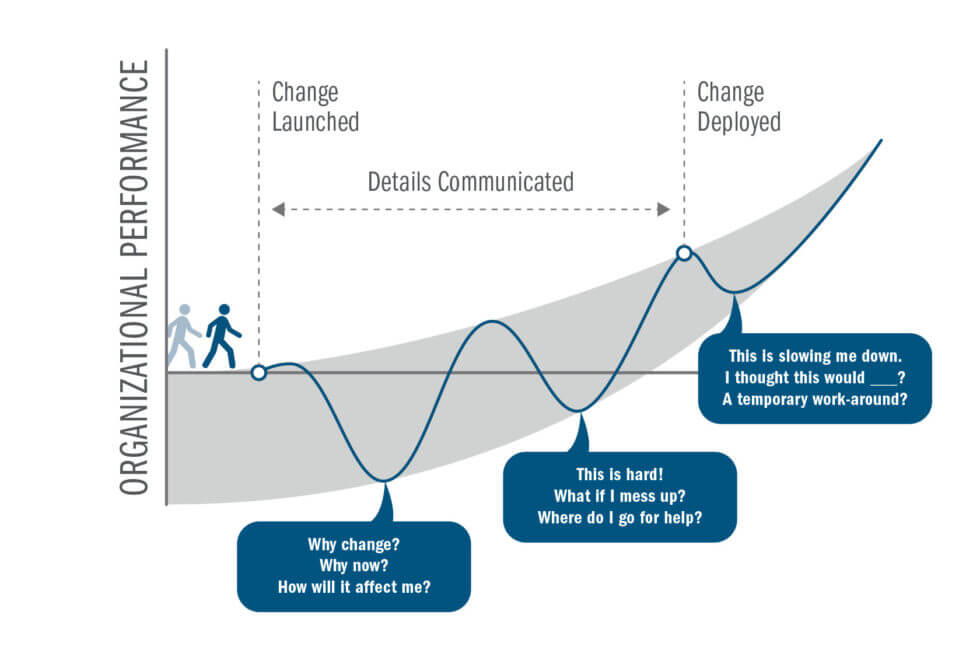
Moving through the phases of the Change Curve gave me new perspective and required me to grow and develop. This shift in perspective changed me and my thinking. If I had known six months ago what I know now, I probably could have avoided some sleepless nights. But this was the path I needed to follow to hit my breakthrough. And if I’m honest with myself, this breakthrough was made possible because we joined forces with TiER1.
As I reflect on this experience, I can say with confidence that I am now in the last stage of the Change Curve. The fusion of ABR with TiER1 has fueled a new energy in me. Something that propelled such anxiety six months ago now fosters an incredible amount of excitement at the opportunities that lie ahead. The coming together of our two companies is good for me, good for our legacy team, good for the larger team, and most importantly, good for our clients.
I’ve learned a lot from this experience—most importantly that, while science helps us manage change, coming together as a team during change truly is an art form. As human beings, we bring our own biases and experiences to everything we do, which impacts our ability to adapt change. So here are three lessons from a self-proclaimed change laggard! I hope they help you and your team come together through change.
Let go and trust.
Amy asked me to trust her when she shared the acquisition news with me. At the time, because I was in the beginning stages of the Change Curve, I wasn’t emotionally able to do this. While I have the utmost respect for Amy both professionally and personally, I was hesitant to simply accept that this change was not only going to work out, but be better. I had an immediate need to analyze and synthesize this new environment, and to figure out what the future state would look like. (After all, I’m a thinker.)
Now I recognize that not everything has to be figured out all at once. In fact, when faced with change, one of the best things you can do is give yourself space to just be for a while. I needed to trust that I would find the right path when I was emotionally ready, and becoming emotionally ready can take time. Allowing your team to have some time and space during the change will allow them to be there for each other as they go through the transition.
Use compassion to combat irrationality.
I’m not going to embarrass myself by sharing some of the thoughts that went through my head during this journey. Suffice it to say, they were irrational. But then I had the opportunity to chat one on one with my new president, Greg Harmeyer.
In typical Greg fashion, he genuinely asked me how things were going. I responded by explaining that I was in a dip on the Change Curve. His response? “Well, that’s to be expected. Change is really hard.”
With these words, he reminded me that it’s normal to feel the way I did in my change journey. This was a pivotal moment for me in my efforts to squelch these thoughts and get back on board with the broader vision. You can expect your people to have an emotional response to change. Empathy can help them believe that organization will be better as a result of the change.
Assume positive intent.
This experience has reinforced for me the impact that our thoughts have on our actions. All kinds of research exist on the power of our thoughts. The more I learned about TiER1 during my transition, the more I saw the world through the eyes of a TiER1er: that we’re all operating to the best of our ability and acting with the best interests of our clients, our company, and our colleagues in mind. So when your team is faced with change, focus on the positive and you will build momentum.
The coming together of any group of people (be it two individuals or two companies) is very much an art, because it involves people. Most of us are messy and imperfect, but together we can help each other be the best we can be. I experienced firsthand that trusting others, receiving compassion, and believing in the good in others can make a potentially messy change feel more like a homecoming.
Want to connect with Elise about her experience with change? Give us a call at (859) 415-1000 or drop us a line in the form at the bottom of this page.

Modernization That Scales Across a Global Enterprise
At a global pharmaceutical company, we partnered to transform the organization to a unified digital user experience across regions while building the capabilities needed to sustain future evolution at scale.
Let’s TalkEmpowering Owners of Transformation Throughout the Business
Over more than a decade, this global biopharmaceutical organization embarked on several growth and transformation efforts including technology modernization and post-merger cultural integration to learning-ecosystem design and future-ready ways of working. Each effort was part of a broader push toward a learning-centric, digitally fluent, globally aligned enterprise to enable their patient-centricity.
The Ask
Launch an ambitious effort to modernize IT and deliver a unified user experience across the United States, Japan, and Europe—aligning stakeholders, activating adoption across 30,000+ employees, and creating scalable frameworks and tools that future initiatives could reuse.
The Approach
- Define the strategy. Co-created a clear change narrative and success measures anchored in productivity, protection, and collaboration, positioning the global unified experience as an enterprise story—not just a tech rollout.
- Align the organization. Built stakeholder maps and alignment tools across hubs; launched a 300+ member Change Champion Network to localize messages, surface risks, and keep feedback flowing.
- Engage your people. Designed a global internal campaign—multilingual assets, visuals, and roadshows—and launched a Tech Ambassador program that connected everyday scenarios to new ways of working.
- Implement and enable. Stood up a SharePoint content hub, editable newsletter templates, and asset libraries; equipped local teams with a practical playbook and toolkit for consistent execution and measurement. This was accompanied by global learning and development strategies and tools to develop the capabilities needed to sustain the digital fluency needed to realize the ROI of the transformation.
The Outcome
- Global alignment across multiple enterprise functions around modernization goals.
- The client experienced positive internal momentum with high user adoption and digital change goals being met.
- Increased activation of core productivity tools in year one allowing better realization of investment return. Replicable frameworks increased efficiency and are used as a blueprint for change initiatives.
- Seamless sustainment of SharePoint hub, toolkits, and channels which were designed for long-term ownership by internal teams. In addition, the Change Champion Network was sustained as the global activation model.

Related Case Studies





ERP Go-Live at Scale: Zero Customer Disruption
After a landmark acquisition doubled the size and complexity of operations, this Fortune 500 enterprise needed to streamline processes, data, and people on a common ERP—without disrupting customers. We built the business-readiness engine that made day-one execution possible and created confidence across the workforce.
Let’s TalkEnsuring Business Readiness
A global enterprise acquired a North American business, creating two sides of the 40,000-employee organization with different systems and ways of working. The company chose to streamline processes and integrate real-time data across functions by implementing SAP as a common ERP across the organization. The magnitude of change—spanning diverse regions, roles, and long-held habits—was compounded by a headquarters relocation and ongoing organizational realignment. The challenge: bring everyone together quickly, consistently, and safely.
The Ask
Lead the people side of a multi-year SAP implementation by establishing a scalable change and learning capability that would prepare thousands of employees, minimize risk, and deliver a seamless customer experience at go-live.
The Approach
- Documented 200+ role-specific change impacts with coaching tools for managers (including 15+ Role Discussion Guides).
- Built a segmented communication program (30+ targeted emails, a 12-part poster/table-tent/site-video series) personalized for specific audiences.
- Designed a transformation website with just-in-time resources and learning tools: 100+ FAQs, 200+ glossary terms, and 28 articles.
- Designed and delivered 70 training courses across finance, logistics, manufacturing, purchasing, planning, business intelligence, and order management. Delivered 1,800 hours of training and 20+ roadshows.
- Enabled consistent, branded communications with a reusable suite of templates (email, Word, PowerPoint).
- Activated 200+ power users and 150 stakeholders to accelerate readiness and sustain adoption through Power User and Change Champion networks to localize guidance and facilitate feedback.
The Outcome
Phase-one go-live was achieved without negative customer impact—orders taken, product made and shipped, invoices issued, and payments processed on day one.
On-time financial month-end close after go-live.
Every change-readiness metric was met between kick-off and go-live; employees understood what was changing and how it affected their roles before training.
Training outcomes exceeded expectations: 80%+ satisfied; 100% said the training would make their jobs easier.
Ultimately, the organization succeeded in streamlining technology and business processes to bring the organization together after the acquisition.

Related Case Studies



Enabling Change Leadership
When change became business as usual, this retailer enabled leaders to create a seamless change experience for employees by providing a brand-right change methodology, easy-to-use tools, and scalable training to enable ownership.
Let’s TalkYour Leaders Can Make or Break Change
This retailer was continually transforming to stay competitive in a rapidly changing market. Sound familiar? With the significant organizational transformation they were prioritizing, the pace of change was outpacing their leaders’ ability to manage it effectively and consistently. This was negatively impacting the employee experience and talent retention. This forward-thinking client saw the need to build an internal capability that would equip leaders to guide change more effectively and create a more unified employee experience.
The Ask
A consistent internal change enablement capability, anchored by a clear methodology, scalable training, and access to easy-to-use tools for leaders and change practitioners.
The Approach
- Facilitated collaborative design sessions to align on outcomes, a tailored change model, and the tools needed to support it.
- A co-created brand-specific change methodology based on organizational culture and strategic needs.
- Weekly practitioner training sessions for HR business partners and learning managers.
- A user-friendly capability portal that housed change tools and resources for just-in-time access and application.
The Outcome
The change enablement model was adopted across departments enabling branded and consistent change communication and roll-out experiences.
Leaders reported increased confidence in their skills and ability to plan and lead change.
The capability portal became a centralized resource for both experienced practitioners and first-time change leaders, increasing efficiency in finding what they needed while ultimately improving the employees’ experience.

Related Case Studies


Building a Thriving, Leader-Led Culture Post-Divestiture
Following a major divestiture, a specialty benefits organization set out to define its identity and activate a distinct culture—fast—by uniting leaders around a clear mission, vision, values, and employee experience.
Let’s TalkMaking Culture a Key to Success
After separating from its parent company, the organization partnered with TiER1 to articulate strategy, foster leader development, and activate a more trusting, empowered community grounded in mutual respect. The first move was to define the moments that matter in the employee experience and activate the desired culture through leaders.
The Ask
Design the desired employee experience (EX) and equip leaders to make the culture real day-to-day by:
- Defining the EX “moments that matter” and how leaders show up in those moments.
- Aligning leaders around shared expectations for EX and living the mission, vision, and values.
- Activating and sustaining the culture through leader behaviors, tools, and supports in the flow of work.
The Approach
- Articulate a company narrative. Together with senior leaders, we captured the organization “at its best” and refreshed the mission, vision, purpose, and values as a rallying cry—providing a clear promise to employees and customers.
- Define the moments that matter. Using design prompts, leaders identified high-impact EX moments—1:1s, learning the role, connecting to the big picture, leading peers, and cross-team collaboration—so effort focused where it most influences engagement and performance.
- Activate culture through leaders. Leaders practiced stewardship behaviors (clarity, connection, curiosity), and we introduced practical assets—Coffee Talk app, care packages with self-care cards, town halls, an intranet hub, a monthly e-newsletter, and a culture video—to reinforce the narrative in daily work.
- Sustain commitment. We branded, designed, and facilitated a high-energy, in-person summit that convened ~100 leaders to connect, align, and affirm commitment to the organization’s purpose, mission, vision, and values. Following the summit, leaders engaged in a multi-month virtual learning journey in cohorts, made visible “collective commitments”, and continued skill-building to sustain commitment and strengthen team belonging.
The Outcome
- A shared cultural language. Leaders were aligned on who the organization is and how to bring the culture to life—described by one senior leader as a true “rally cry.”
- Leaders ready to act. Post-summit surveys showed 96% highly positive experiences and 87% of leaders ready to begin applying what they learned.
- In-flow reinforcement. Always-on tools (Coffee Talk, intranet hub, town halls, culture video) embedded the narrative in everyday work and connection.
- Momentum beyond the event. The three-day summit—plus additional structured connectivity and targeted content over the next several months—catalyzed an ongoing community of practice among ~100 leaders.
- Enduring capability. Leaders now steward and feel ownership for the EX by focusing on consistency in moments that matter, activating a culture of trust, belonging, and performance.

Related Case Studies



Reading the Culture Clues
Cultural due diligence is an important part of solving the people side of the M&A equation.
 Katie Frey – President & COO
 In M&A, doing due diligence traditionally involves a financial and strategic assessment. We ask specific questions—What are the risks and liabilities? What are the market opportunities? —that are useful in considering some factors. Yet, if we don’t know how to assess and manage culture, the people side of the M&A equation can come up short during due diligence.
People are a strategic consideration during M&A. Executives rank the ability to manage culture as more important to M&A success than financial or strategic factors, but they also acknowledge that they tend to undermanage this critical aspect.
Cultural due diligence is an emerging thought, and there are a lot of unknowns about how to do it. The process requires more than a comparison of each company’s articulated values or mission statement. That’s because an organization’s culture is reflected in what’s valued and what’s practiced. Those components may be aligned (on the surface), but the culture for each organization could be dramatically different. And after integration, those differences will impact the collective organization’s ability to deliver value to customers, stakeholders, and employees.
Values AND actions matter
It’s important for us to read these “culture clues” early on to mitigate the impact on all the people involved. Doing cultural due diligence means looking at what each organization professes to value, as well as how those values are lived out at all levels of the organization. Which means we need to talk about habits, or the ways in which people live out their values.

As individuals, teams, and even as organizations, we form habits that align with what we value. The impact of those habits can differ (for example, an individual refusing to use video conferencing versus an entire organization of people not using it).
A basic operational “habit” or process is how decisions are made. Let’s say two companies are going through an M&A. Company A’s decision-making “habit” is that the person in the room with the highest rank or level makes the final call. Yet Company B’s culture encourages the “person closest to the customer” to make the call. These two organizations have fundamentally different principles or values in decision-making, as well as different habits in seeing those values come to life. When you attempt to blend those cultures, there may be clashes in understanding and decision-making authority, unless those differences are identified and managed ahead of time.
Here’s another example: If Company A places high value on workplace flexibility, it may be culturally acceptable to work from home as much as possible. The organization may even offer financial incentives for doing so (such as offering a stipend, meaning workspace rent is lower with more employees working from home). That’s a financial and cultural decision that impacts several aspects of operations, while also recognizing what and where employees place value. And the end result is a culture that looks and feels very different from Company B, which values face-to-face contact in the workplace and limits the number of hours employees may work from home.
Put another way, “The available evidence suggests that…poor sociocultural integration will block successful task integration, and task integration cannot be driven faster than success with sociocultural integration.”
Considerations for cultural due diligence
To get a deeper look at a company’s culture during the M&A process, we must be to ready to “read the clues” during cultural due diligence. Take stock of the following components and ask yourself, How are these elements showing up within this organization?
Rites and rituals (e.g., celebrations, activities)
“Heroes” (those who are recognized as personifying the truest form of values)
Communities and networks
- How does the company convey the necessary information to get the job done?
- What about social outlets and interaction between others?
- How are these networks bringing new members into the culture and reinforcing the organization’s cultural messages?
Codes and norms (the “rules of engagement” in an organization, often articulated in the form of policies and procedures)
Stories, myths, and legends (company history and other stories that embody the organizational culture and emphasize what the organization values)
A thorough culture assessment and corresponding map of these and other elements can help organizations intentionally plan how they will evolve together. This requires a commitment from leadership to invest the time and energy required to create an integrated culture that will fully activate the broader strategy.
Reading the cultural “clues”
Every M&A deal is unique. What (and who) you will have access to during the due diligence process varies, and sometimes we see only part of the picture. Pay attention to what’s glossed over or taken as a given. Those are the things that often carry the heaviest cultural weight or have the most significance to employees.
The answer to a successful M&A isn’t necessarily to find a partnering organization with a similar or compatible culture. Rather, there must be intentional management of those cultural differences that builds cultural understanding and promotes creative synergies. Cultural due diligence is just one part of the M&A process, but it’s an important one to address early on.