Talent & Skills

Driving Adoption of HCM Systems
To unlock the full potential of your HCM suite, go beyond the technology and drive people readiness as well.
 TiER1 Performance
 As the role of Human Resources (HR) has shifted and transformed, with an increased focus on optimizing the workforce experience, HR technology has also transformed. We’ve seen the shift from transactional personnel systems of record to transformational data-rich platforms. Newer Human Capital Management (HCM) suites offer more to organizations than their predecessors, such as the ability to automate workflows, leverage artificial intelligence (AI), collect and share real-time data, and truly optimize workforce experience. Yet, driving adoption of HCM tools can be complex, as the learning curve is steepest around new ways of working, not the technology itself.
As you embark on your HR transformation journey, accompanied by the integration of HCM technology, here are some strategies to drive HCM adoption and, in turn, deliver on long-term value for your workforce and the organization. (To put these insights into action, check out the Driving Adoption of HCM Systems Checklist.)
1. Start with data
One of the most powerful benefits of new HCM technology is access to data and trends that can equip HR and leaders to make more informed decisions about the workforce. Being able to articulate the value of this change to the organization and how it will impact their everyday jobs is imperative. With some HCM tools, leaders have real-time access to headcount, performance, tenure, compensation, diversity, and engagement, with the click of a dashboard. There is inherent power in HCM data and getting it right early in the process will exponentially accelerate HCM adoption.
Amber Battaglia, Sr. HR Operations Manager from PNC Financial Services, shares, “Give yourself enough time to understand and evaluate the data prior to and throughout the implementation. With data being a core and foundational component of a large transformation, rushing any exercise around this can create long-term irreversible issues with your business processes, integration work, and adoption.”
2. Assess for broader impact
Invest time into assessing stakeholder groups and broad impacts, going beyond technology to also identify relational, capability, process, culture, and business impacts. HCM adoption is accelerated when people have a clear understanding of not just how to use the technology, but why, when, and who to work with as part of the process.
Adoption is also aligned with the desired employee experience and long-term business strategy. Often, the working relationship between HR, managers, and leaders might change as a result of an HCM integration. It’s important to know those impacts early and build clear communication, alignment, and learning tactics in your HCM adoption plan to address them.
3. Orient messaging to value
Let’s face it, HCM integration is often the hardest for managers. Engaging stakeholders early in the process and clearly articulating the long-term value of the technology can directly impact the rate and speed of HCM adoption. To accomplish this, messaging needs to be directly oriented to value for each stakeholder group. For example, your managers might want to know what they will be asked to do and how this will help them manage their team. Similarly, leaders and executives might want to understand how data aggregates to key metrics around retention, diversity, engagement, and cost. HR business partners might want to know how they can help support their leaders in a more strategic way and how the technology can help them accomplish that. Messaging matters, and addressing the needs, wants, gains, and pains for each group will set you up for success.
Missy Paxton, Director, OCIO at Mylan, shares, “It’s important to remember that investment in technology is made with an intention to provide an outcome. All stakeholders, those consuming, implementing, and buying the solution need to understand that outcome and the part they play in achieving it. Think about your favorite sports team – the outcome is to win the game, and every player understands what they need to do to help their team win. Just like a sports team, every stakeholder group needs to see themselves as part of the team to make things happen. This effort isn’t easy. It takes alignment, practice, dedication, communication, and a clear vision of the goal. Whether it’s blocking and tackling or going for the goal line, when everyone is aligned to the outcome and how they contribute, it’s a winning formula!”
4. Build HR and manager capability and role clarity
HCM technology training is often straightforward and building a bank of step-action resources for stakeholders to use in the moment is a standard best practice. That said, HCM often comes with significant changes in process and workflow that happen outside of the system. These changes might shift ownership of certain activities that have historically been owned by HR to Managers (e.g., creating a requisition, adjusting compensation, or separating employees). HR’s role often shifts to a consultative function and partner to managers, instead of performing tasks. It takes time and intentional effort, both communication and learning, to build these skills for true HCM adoption.
Maria Raymond, Global Leader of People Insights at PPG Industries shares, “Our global WD implementation included building a tier 0 learning tool, the PeoplePulse portal, which is enabled through ServiceNow technology. Our implementation team documented our core HR processes and created supporting knowledge articles and quick reference guides that clearly articulated the role of the HR Manager and the leader. In addition, we provided video tutorials and a comprehensive manager guide. And we continue to refine our approach! We recently conducted surveys and end-user focus groups to better understand how people are leveraging the portal. The result is a refreshed landing page and article updates to maximize our search results.”
5. Design for the moment of need
Unlike ERP Go Live events, HCM adoption is a slower climb as system usage is based on moments of need, both short term (hiring, separating employees, etc.) and longer term (performance, talent review succession planning, etc.). Adoption needs to be managed and measured over a longer period (at least one calendar year) after Go Live, and the interventions to support should be designed accordingly. Instead of conducting heavier upfront “system training,” we see better results in increasing communication to drive awareness and understanding, followed up with tools, resources, and support for those moments of need and building muscle across the organization on how to find those resources when they are needed.
Susan Bonidie, Director of Learning & Development at Eaton, shares, “Communication and learning are on an experience continuum, and organizations need to choose the right intervention via the right channel at the right time to help stakeholders make the mental and technical leap to new ways of working. One size, one time does not fit all, and we need to design with that in mind.”
Driving HCM adoption
Taking the leap to upgrade your HCM technology is a strategic decision that will certainly enable your organization to optimize your workforce experience, achieve business outcomes and deliver long-term value. Having a clear vision for data, a laser focus on your stakeholders and their role in creating value, a strategy for building capability and the right tools and resources integrated into the flow of work will accelerate HCM adoption and the return on your capital investment. After all, the potential of every organization lies within its people.
Like these insights? Put them into action with the Driving Adoption of HCM Systems Checklist, or check out the following insights on:
Why People Readiness Matters for Systems Adoption
Driving Adoption of Agile Sprints
Driving Adoption of CRM Systems
Driving Adoption of Microsoft 365
People Readiness and ERP Implementations
If you’d like to connect with our team to learn more about driving HCM adoption through people, give us a call at 859-415-1000 or reach out through the form below.
Driving Adoption of Agile Sprints
Tips for driving the adoption of Agile Sprints and putting them into practice with your teams in the context of our new normal.
Co-authored by Ian Herzog and Nick Pineda.
TiER1 Performance One way of working that has caught momentum in system implementation projects is the use of Agile methodologies such as the scrum ceremony known as Sprint Planning, or Agile Sprints. While many organizations have done a good job learning the language of this approach, they are still struggling to adopt the enabling behaviors.
Unfamiliar with Agile or sprint planning? No problem! Throughout this article, we discuss these concepts and how to best drive the adoption of Agile Sprints and put them into practice. Below are the steps your teams can take to best adopt this powerful activity in the context of our new normal.
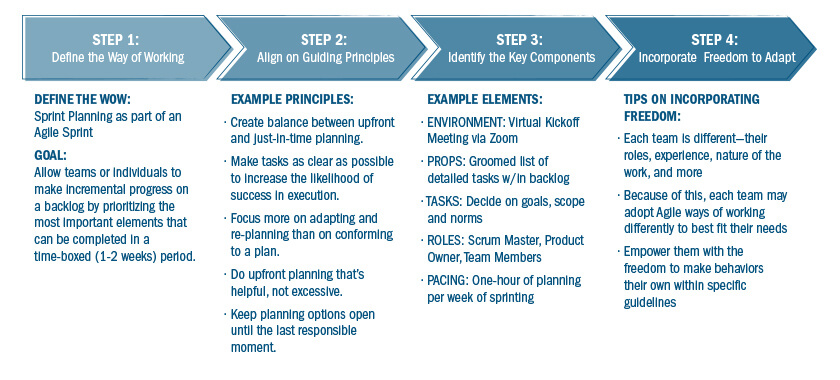
1. Define what “Agile Sprint” means for your team
While you might not fully subscribe to a “pure Agile” practice, there are many activities and philosophies you can adopt from Agile to create ways of working that, well, work for you and your teams. Working in an Agile way means planning enough in advance to move quickly towards creating value while still allowing the team to adapt to changes over time.
A great way to achieve this in practice is by using Agile Sprints. We won’t get into too much detail here, but a quick summary of an Agile Sprint is for a team, or individual, to work on the highest priority items within a specific amount of time. Many teams choose to time-box their sprints to 1 or 2 weeks in duration. The team kicks off their sprint with a Sprint Planning meeting where they review all the current tasks in their backlog and commit to completing a subset of highest priority tasks.
2. Align on guiding principles for Agile Sprints
While working through the process, it’s best if the team aligns to a few guiding principles. This helps the team make decisions quickly and move forward. For Sprint Planning, some core principles we recommend are:
- Create balance between upfront and just-in-time planning.
- Make tasks as clear as possible to increase the likelihood of success in execution.
- Focus more on adapting and re-planning than on conforming to a plan.
- Do upfront planning that’s helpful, not excessive.
- Keep planning options open until the last responsible moment.
3. Identify critical components of Agile Sprints
Best practices recommend sprint planning should take about one hour per week of sprinting. For a successful sprint planning session, it is important to identify critical components well in advance. First, define the goals, scope, and behavioral norms for the sprint to provide clarity and alignment. Second, key roles such as scrum master, product owner, and team members with relevant skills should be defined to ensure team cohesion. Finally, the backlog of work to be performed should be as detailed as possible and ready in advance of the sprint planning activity.
4. Incorporate freedom to adapt
Each team is different—their roles, experience, and work can be unique. Because of this, each team might adopt Agile ways of working differently to best fit their needs. We recommend balancing your focus on what you’ve lost with what you’ve gained when it comes to pivoting to a new normal. For example, you might consider looking at your new way of working and being explicit with your team about which components are completely fluid, somewhat flexible, and should be kept fixed.
The following list of old and new norms calls out some of the pros and cons of remote or hybrid sprinting and sprint planning.
Old Norms:
- Way of working is intuitive, especially when all are physically gathered.
- Team members participate one at a time.
- Physical sprint boards are easy to visualize.
- It takes time to make physical cards (though this keeps messages simple, as cards can’t be overloaded).
- Interactions are primarily face to face between local or analog teams.
New Norms:
- Way of working is less intuitive, but “attention” to the work can be distributed and asynchronous with automated updates and alerts.
- Team members participate all at once (though turn-taking for conversation is still important).
- Virtual sprint boards are harder to visualize, but make it easier to track changes, review history, and sort and filter.
- It’s much faster to create cards, but they can get overloaded with information. Some information is helpful, though (e.g. attach documents and control permissions).
- Interactions are primarily face-to-screen across distributed, hybrid, or remote digital teams.
As you can see, there is a mix of pros and cons for Agile teams between the old and new working norms, especially in a virtual setting. The lack of face-to-face interaction might mean designing intentional face-to-face moments.
If you want to engage associates in adopting Agile Sprints, then empower them with the freedom to make behaviors their own within specific guidelines. As a leader, encourage teams to design these activities to maximize capacity for new strengths. Get “meta” with Agile by not only pivoting through the work, but also pivoting the way you work to take advantage of changes in tasks, teams, roles, environments, and pacing. In the end, this is just one example of the new normal we are all adapting to, and the need to adapt will long outlast our current COVID-19 context.
About the Authors:
Ian Herzog is a Senior Solutions Consultant at TiER1. His diverse background includes creative and digital design, project management, process and operations improvement, change management, UI/UX, and software application development. He also has extensive experience leading client engagements in government and research. When not partnering with clients to develop new solutions for complex problems, he enjoys woodworking and anything outdoors.
Nick Pineda is a former Director of Innovation at TiER1. He loves enabling teams and leaders to unlock their hidden potential to pursue bold visions for growth and transformation. Nick translates his passion, energy, and practical experience into innovative perspectives grounded in real-time, real-world impacts for clients. Fun fact: he’s a former professional rugby player representing the Philippines against Hong Kong, Malaysia, and South Korea.
Like these insights and want to read more? Check out the following insights on:
Why People Readiness Matters for Systems Adoption
Driving Adoption of CRM Systems
Driving Adoption of HCM Systems
Driving Adoption of Microsoft 365
People Readiness and ERP Implementations
If you’d like to connect with our team to learn more about Agile Sprints, give us a call at 859-415-1000 or drop us a line below.
A Winning Approach for Navigating Complex Data
How Delta Air Lines leverages data to ensure pilot training program effectiveness and provide real-time, role-based actionable insights.
 Ani Matrai-Monk – Sr. Consultant
 This article originally appeared in The Data & Measurement Issue of Performance Matters magazine. Download a digital copy of the magazine to read more on this topic.
As one of the largest U.S. commercial passenger airlines with an extensive network of domestic and international routes, Delta Air Lines supports 15,000 pilots flying a massive fleet of multiple aircraft types, each with numerous configurations, making their pilot training program the largest and most complex in the world.
Pilot training at Delta poses a unique challenge: data saturation. Across the organization, terabytes of data are collected daily and flowing in constantly from individual flights, irregular events, equipment use, maintenance operations, employee and business performance, and training programs. Bringing together huge amounts of different types of data in a meaningful way, correlating the data, and understanding implications on business and training performance is easier said than done.
That’s why Delta’s Flight Operations, Pilot Training team partnered with TiER1 to better understand the performance and effectiveness of their training programs across key performance indicators. Together we sought to answer this seemingly simple question: “How is our training program performing?” The team’s executive stakeholders and decision-makers needed a comprehensive view of Delta’s extensive pilot training footprint to compare the many components within its vast curricula. Together we defined the team’s goals:
- Identify cost-effective training approaches
- Troubleshoot and pinpoint issues in real time
- Remedy issues in real time (or prevent issues before they even happen)
- Turn data into actionable insights
We then worked together to build a single-source solution that demonstrates and visualizes pilot training program effectiveness and provides real-time, role-based actionable insights. Keep reading to learn more about the team’s winning approach.
Making sense of the data
Delta, like many organizations, has a lot of data that are collected and managed by siloed groups in various departments. Those groups analyze and report on the data to their functional leaders, and that is often where the story ends.
The hard truth is, no single data source can answer a complex question. In the parable of the wise men meeting an elephant in the middle of a dark night, when each one examined just one portion of the elephant—the trunk, the tail, the tusk—independently of each other, they arrived at the wrong conclusion, thinking it was a garden hose, a broom, or a very large spear. The key is to combine all findings to understand the full picture: the elephant. In Delta’s case, the “elephant” is the entire pilot training footprint.
Many organizations use simple post-training surveys to determine the success of their training programs. Unfortunately, the data are not reliable to determine training effectiveness. Learners may be happy with the training program and provide positive feedback, but this doesn’t reflect their actual performance in post-learning evaluation (grades). And if learning doesn’t transfer to tangible business performance (e.g., pilot flying skills or safe aircraft operation), the training program is ineffective, even with stellar post-learning evaluation and learner feedback. (For an example of learning evaluation done well, visit here.)
Collaboration
Historically, data—pieces of the “elephant”—have been siloed at Delta across various data management teams. To build a shared collective understanding of the available data generated, we supported the team’s identification of data owners and channels of communication across these siloed working groups. By creating collaborative networks with these executive decision-makers, the team is empowered to design solutions that address the needs of the business in a meaningful way.
Data integrity
When building a database for analysis, actionable insights are only as good as the supporting data. To see the entire “elephant,” you need reliable information to guide you toward the correct actions. The consequences of faulty decisions based on bad data can be extremely costly and dangerous in the airline industry; data integrity is critical for Delta.
We considered the following steps to build a reliable database to inform actionable insights:
- Identify all available data sources. What data are currently collected? Who owns which data? Where are the data stored? In what application and format?
- Select and use the relevant data and discard the rest. Which data are relevant to the question we are trying to answer? In Delta’s case, flight performance, flight safety, and pilot errors are directly correlated to learning and are necessary to understand training effectiveness.
- Identify any missing data showing up as gaps in the big picture. To fully understand Delta’s training effectiveness, we collected feedback from training instructors. Qualitative data from instructors helped answer questions regarding specific issues during training with training equipment (such as simulators and flight training devices) that often led to training delays and additional costs.
- Determine data quality: Garbage in, garbage out. How reliable are your data? How “clean” are they? Are they comprehensive enough to provide a meaningful insight? For example, post-training surveys returned by only a few participants are unreliable in determining how the program is perceived by the whole learning group.
- Include qualitative data to answer the “why.” Numerical data inform us of performance gaps and potential opportunities for improvement (the “what”). Yet they cannot show how we got here and how we move forward (the “why”). Qualitative data is crucial when searching for actionable insights. When used carefully with reliable quantitative data, qualitative data can help reveal the reasons behind the performance issues highlighted by the numbers.
Bringing data to life
After identifying and correlating the right data sources, our next step was to build a user-friendly, single-source solution that effectively visualized the findings and provided the insights for making decisions about necessary changes to the training footprint. We recommend the following steps to anyone designing a similar solution:
- Select the right tool. Combining multiple data sources with different formats that are hosted in various data warehouses or applications requires the right tool that can bring together all your data under one roof and can offer the necessary capabilities for data collection, mining, and visualization to process and present the data in a meaningful way. Based on Delta’s needs, we considered tools with capabilities such as robust survey design (e.g., branching, filtering, advanced text analysis), advanced visualization (e.g., highly configurable dashboards capable of combining multiple data sources), and 24/7 access to up-to-the-minute live data on any device.
- Consider your audience. Executive stakeholders and decision-makers are focused on the business. They are not necessarily data experts. The focus should be on translating raw data into information, and then the information into digestible, intuitive, and actionable insights for stakeholders and decision-makers. This translation is a key step to help bridge the gap for non-data experts when it comes to understanding what the data mean, how they affect the operation, and what actions should be taken.
When designing Delta’s dashboard solutions, we applied three key principles: simplify, visualize, personalize. Using these strategies helped us create a user experience that made it easy to access use-case-specific information quickly and efficiently, while also allowing users to filter or modify their views and search results based on a specific issue or focus area.
- Simplify. The goal is to convey information in clear, easy-to-understand, digestible chunks. Focus on the most important pieces. Show what needs to be seen first. Do not fall into the trap of trying to squeeze everything on the visible screen area. Move from the general to the more detailed. Once the most important (or top level) information is surfaced, allow users to dig deeper and drill down to the details.
- Visualize. A picture is worth a thousand words. Intentionally use color coding to help draw the eye to the most important information. Highlight the “big picture” or overall results using large font and diagrams. Apply consistent standards for page organization so that no matter which dashboard the user is viewing, they can always see the same type of information in the same areas of the page.
- Personalize. Users need to access the information they need in the shortest time possible. Identify unique use cases—the different ways that users need to see the data in their distinct roles. Build personas around each use case. Design persona-specific dashboards showing different views of the same data to surface relevant information based on real needs. Apply multiple filters to allow users to focus on specific information; filters for Delta included fleet types, specific training programs, target pilot functions, tenure, and age groups.
Rolling out the solution
We introduced the pilot training dashboard solution through a carefully crafted adoption plan. The dashboards were first shared during the kickoff meeting at the start of Delta’s recurring training design process where all key stakeholders and designers were present. Using the dashboards, the team demonstrated the results of the previous nine-month training cycle and its impact on learners, training results, and business performance. The dashboards surfaced practical insights with immediate applicability for how to move forward with training design for the upcoming training cycle. We answered questions about the data and the dashboard itself. Each stakeholder also received access to a persona-specific dashboard so they could discover and explore the tool on their own.
In the following weeks, each “persona group” (users with the same dashboard view) received basic data literacy training plus targeted dashboard user training on how to use the tool, access different views, and filter results to dig deeper. Time was carved out for step-by-step practice of the most common daily uses for researching data and insights, answering questions along the way. We also provided a detailed user guide for reference and set up a support line to address questions and issues.
The reception of the solution was extremely positive and was promoted by top executives across the Fight Operation training organization, and it’s still being used by the organization today. With the number of role-based users continuing to expand, the training team continues to add new personas for the dashboard. Building these persona-based pilot training dashboards provided an exciting opportunity for both Delta and TiER1 to solve for the problems of data saturation by bringing together people and translating complex data to easily consumable and meaningful insights, accessible anywhere, anytime.
The Neuroscience of Gratitude
Understanding the art of gratitude and positive thinking through neuroscience.
 Elise Greene Margol – Principal
 The world feels heavy right now. So much violence. So much hate. So much division. It’s exhausting and frankly overwhelming. The ripple effect world events have on organizations, their people, and their performance can be intense. I for one find it impossible to ignore what’s happening especially when it’s in my back yard. As I listen and watch news stories unfold, I find myself filled with sadness and dread. But I also know the energy for initiating positive change doesn’t come from a mindset of sadness and dread. It comes from a mindset of optimism and hope. Gratitude can be a pivotal factor in achieving that shift.
The neuroscience of gratitude
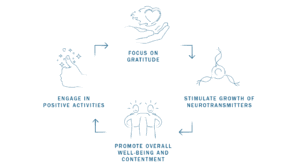
Shifting our mindset to focus on the good acts as a natural antidepressant. Neuroscience research has found a link between positive thoughts and the activation of certain neurotransmitters (chemicals released from our nerve cells that inform other parts of our body).
When we focus our thoughts on good, we feel good, which then informs our actions. Feeling good is what enables us to engage in activities that fuel us. It helps shape our essence, how we perceive the world around us, and our ability to analyze and reflect.
You know those people who, no matter what, always see the glass as half empty? Well, they’ve trained their brains to revert to negativity. The field of neuroplasticity tells us that our brains continue to evolve as we respond to different situations, which gives us the ability to create new patterns of thinking based on the situation. This means we can reshape our thoughts by being intentional and using repetition, giving our brains a new pattern to follow.
We have the power to change our mindset by focusing on gratitude. Here are three simple ways you can start developing a gratitude mindset today.
Say “please” and “thank you.”
What’s the magic word? If you’re like me, you’ve used this a few times with your children. Saying “please” and “thank you” are the foundation of good manners. But many times, we forget the power they possess, especially in a corporate setting.
At our core, what binds us together is a desire to feel valued and appreciated. We all want to feel appreciated. And showing appreciation for others is the place to start. It projects an attitude of gratitude. It tells others that we appreciate and value their actions. Not only have you made them feel good, but you’ve reinforced their behavior.
Saying “please” is about asking permission. Saying “thank you” conveys our gratitude. If your team isn’t doing this on a regular basis, begin to slowly introduce them. Find ways to show appreciation that is meaningful to each individual. See what happens.
Use self-talk to redirect your thoughts.
To successfully create an attitude of gratitude, we must learn how to redirect negative thoughts. For me, sometimes those negative thoughts seem to take over, usually as self-criticism for something I did (or didn’t do). I have grown to accept that these feelings are natural and provide space to appreciate the good even more.
Now when I hear negative thoughts in my head, I use self-talk to point myself in a different direction. It’s my choice how to handle these thoughts. I can either allow these thoughts to perpetuate or I can talk myself into a different direction.
Self-talk might look different from one person to the next. For me, I literally tell myself to stop going down the rabbit hole. I then conjure up the many things I’m grateful for, such as my loving family, my amazing children I’ve raised with my husband, and the incredible community of people I get to collaborate with daily. Try it—you may like it!
Keep a gratitude journal.
Developing a journaling practice is a simple way to shift to a gratitude mindset. It does not have to be time consuming. Devote a few minutes each day at the same time to write down two or three things you are thankful for. Implementing a cadence around focusing on gratitude is what helps us create that pattern in our brains that we want—seeing the glass half full instead of half empty.
A gratitude journal also promotes mindfulness. In a time when we’re constantly racing to the next thing on our to-do list, it can be challenging to stay present. Mindfulness is the practice of focusing our attention on the present moment, which has also been linked to neuroplasticity. There are many ways to intentionally focus on being mindful, but starting with a gratitude journal is an easy way to begin. Just the act of devoting a few minutes a day to writing down what we are thankful for means that we are being mindful. Remember, you don’t have to keep this practice to yourself. Teams can benefit by celebrating individual moments of gratitude before meetings or on your internal social platform.
The life-changing importance of gratitude.
The current events of our world can invoke sad, even despairing, thoughts. My hope is that we can begin shaping our thoughts to focus on gratitude to help promote more happiness in our communities. By developing a gratitude mindset that focuses on the good, we will have more energy to do good things—at work and beyond.
Would you like to connect with Elise? Give us a call at (859) 415-1000 or drop us a line in the form at the bottom of this page, and we’ll put you in touch with her.
Making Strengths Stronger
Written by Sherri Donnelly. Practical advice for maximizing the impact of strengths for your people and the organization.
TiER1 Performance When you think about becoming a stronger leader, employee, or even organization, do you focus on your weak spots or do you start with where you’re already strong? For years, the traditional paradigm had us focus on directing development activities to fix what we weren’t very good at. After all, if something is already considered one of your strengths at work, why focus energy there? Shouldn’t we focus on a weakness instead?
Well, according to Peter Drucker, “It takes far less energy to move from first-rate performance to excellence than it does to move from incompetence to mediocrity.” Research has shown that the emphasis on weaknesses doesn’t provide the same level of impact as focusing on strengths. Leadership development firm Zenger Folkman studied 24,657 leaders who participated in 360-degree feedback assessments. The firm found that “regardless of how much effort [leaders] spent on correcting weaknesses, their efforts would only bring them to the midpoint on the overall measure of effectiveness.”
Let’s think about the activities we enjoy. For me, I love being in front of groups of people sharing ideas and learning from one another. I’ve always been comfortable in that space, but it has taken practice, education, observation, and time to hone my facilitation skills. While it wasn’t always easy, I loved the energy I got from developing my strength! When we give attention and focus to making our strengths even stronger, it adds to the energy that the strength already provides to our work.
Knowing your strengths at work and how to maximize their impact leads to enjoying work more, working with others more productively, and, ultimately, getting better results.
Figuring out our strengths
To empower this strengths-based approach, many organizations turn to the Gallup StrengthsFinder 2.0® assessment because of Gallup’s status as a leader in helping individuals and organizations bring strengths to work. However, the cool thing about focusing on strengths is that we’re not limited to just StrengthsFinder 2.0. There are many assessment tools available to identify areas of strength and energy that are ripe for professional development and increasing engagement.
No matter which assessment you take, knowing what to do next—what to do with your results—is usually the biggest question. What does it really take for individuals to build up their strengths and bring their best self to work?
As Gallup’s State of the American Workplace Report tells us, when an employee has the ability to showcase their best self on a regular basis, engagement increases and productivity goes up. Stronger individual performance leads to organizational benefits that, ultimately, carry over to clients and customers (heck yeah!).
Yet, according to Marcus Buckingham, co-author of Now, Discover Your Strengths, only two out of 10 individuals acknowledge being able to bring their best self at work. So, how do we influence this statistic in an upward direction? We can help individuals initiate momentum and realize their potential by encouraging them to learn, develop, leverage, and promote individual strengths.
To see what this approach looks like in action, I’d like you to meet Jessie. Jessie has recently transferred to a new division within her company. As part of her transition, Jessie’s team leader asked that she take the StrengthsFinder 2.0® assessment.

Her top five strengths at work are Communication, Arranger, Learner, Responsibility, and Includer. Jessie loves the idea of using her strengths in her new role, but she’s not quite sure how to go about doing that.
Learning about strengths
First, we want to help Jessie learn more about her strengths. Learning can take place in many forms. Since Learner is one of Jessie’s strengths, she decides to read the reports on each of her strengths to have a good initial overview. She also checks out the resources provided by Gallup for each of the 34 strengths.
To really learn about a personal strength is to understand how the context provided by the assessment company resonates to the individual. Questions an individual might ask include:
- Do I agree with the results?
- What about the results gives me energy and satisfaction?
- Do I recall how these strengths have helped me to succeed in the past?
Making connections with how she sees her strengths in action will help kick off how Jessie invests in, practices, and further develops her strengths at work.
Developing your strengths
Developing a strength is an investment in yourself. Just because you have a natural talent doesn’t mean it can’t use some extra polish to take you to the next level. For Jessie, having knowledge about what gives her energy and satisfaction allows her to stretch her muscles and develop her strengths.
Take her Communication strength—she is at ease sharing and articulating details to others. In her previous role, Jessie only had to share information in one-on-one situations. In her new role, she’ll need to develop her strength to be just as comfortable sharing information with larger groups. Lucky for her, each time she holds a team meeting she’ll be investing in and building up her Communication strength.
Be aware that each strength also has a shadow side. Any strength, when overused, may manifest itself as a potential weakness. For example, Jessie’s strength in Responsibility often causes her to overcommit to projects due to her sense of ownership and need to follow through on a promise.
We don’t want her to lose this work ethic, but her awareness of the shadow side to her Responsibility strength can help her identify when it is necessary to say no, delegate, or get others involved.
Leveraging strengths
So, what does it really mean to leverage a strength? To leverage means to use something to its maximum advantage. Once Jessie has some context and understanding for how her strengths benefit her, she can start thinking about how to use her strengths at work for maximum energy and impact. For example, Jessie leverages her Includer strength by inviting her new team to be involved as she learns about the team dynamics and builds relationships with her team members.
Leveraging your strengths requires a change in thinking. Keep in mind, though, that it doesn’t mean you should ignore what you’re not so good at! Think about how to change the perspective from “I’m not very good at that” to “How can I use my strengths to approach this situation differently?”
As leaders, it’s important that we help employees align their strengths with the expectations and responsibilities of their roles. In Jessie’s case, this will allow her to stretch her comfort zone and enhance her skills.
Promoting strengths in ourselves and others
Jessie knowing her strengths is just the first step. When all individuals throughout the organization are involved in learning, developing, and leveraging their strengths, it can exponentially increase engagement and productivity. Promote individual strengths by posting them in your work area for others to see. Keep the conversation going by talking with others to learn more about their strengths. This dialogue helps individuals see how their strengths can complement each other, balance weaknesses, or even contribute to conflict if not properly managed.
This strategy of promoting strengths works to Jessie’s advantage: she learns her coworker Terry has a high Achiever strength, which means he’s always motivated to accomplish things. Jessie partners with Terry, leveraging his drive to complete initiatives to help her implement new process flows she was considering for the team!
Strengthen those strengths
Shifting the paradigm from fixing weaknesses to building strengths takes no small amount of energy and attention. Yet, when organizations provide opportunities for employees to bring their best selves to work, everyone wins. Being intentional in supporting and promoting that shift can lead to higher employee engagement, productivity, and retention—all of which, ultimately, creates a stronger team and organization.
If you’d like to connect with our team to learn more about being a strengths-based organization, give us a call at 859-415-1000 or reach out through the form below.
Redefining Onboarding
Onboarding has the power to transform organizations and how people relate to them. Here's how.
 Dustin Shell – Director of Organizational Development at TiER1
 Redefining Employee Onboarding as a Journey
Given that up to 20% of employee turnover happens in the first 45 days and 34% occurs in their first year on the job, it’s not a stretch to say that the current onboarding approach isn’t working for many organizations.
Other factors may come into play, but we believe turnover happens when we don’t treat employee onboarding as a journey—one that starts before sending the offer letter and ends when the person is performing the role independently and confidently.
Employee onboarding typically has a narrow definition: orienting new hires to the company and their role. In some circles it simply means a new hire’s first day or week on the job. Yet, when you think about the impact onboarding can have on organizations—growth, people development, scalability, quality, customer and employee experience—a much larger picture starts to come into focus. It’s not enough to think of it as a single day or week; depending on the role, the onboarding journey could take months or even years.
It’s also an emotional journey. People leave organizations when they feel disconnected, overwhelmed, frustrated, or undervalued. Onboarding should help people feel confident in their new role as well as competent. Yet, the typical onboarding approach fills people up with everything they need to know or do before being sent to do their job without supporting that emotional journey.
How employee onboarding transforms organizations.
Onboarding has applications that organizations may not typically recognize—like ensuring knowledge is retained and passed on. Baby boomers will continue to retire over the coming years (whether it’s in a burst or it happens in gradual waves). How can we capture and share their knowledge across generations? By building an employee onboarding experience that systematically trains people on the roles, mindsets, and processes that currently live in the heads of your most experienced employees.
Onboarding isn’t just for new hires. Your people are always in a state of mastering their current role and taking on new ones, which is why onboarding can apply to role transitions and advancement, too. (Depending on the organization, it can be called inboarding, role transition, or even promotion.) It’s incredible how agile an organization can be when people have the control and autonomy in their career development to navigate and explore new roles.
Another onboarding application is scalability. Many organizations wrestle with how to scale their business, especially if there aren’t enough good managers or their managers are overworked. Onboarding enables us to capture and share the “best of the best” of a role to empower others to own their development, which eases the burden on overworked managers and puts more emphasis on the individual.
Onboarding is also a great organizational alignment tool. The rise of complex HR systems has reduced the need for HR staff; learning and development roles are shifting to be content curators and consultants. Onboarding unlocks the real value of these functions by allowing us to systematize the people side of business. It becomes a thriving system that multiple people own, buy into, and impact instead of relying on one person to work.
Let’s take a look at three factors that can help redefine employee onboarding at your organization:
1. Consistent brand experience.

When organizations are small, they focus on getting their product or service right (and they should!). Business success is directly tied to creating a consistent brand experience for customers. That brand experience builds customer loyalty and trust, which generates demand and growth.
The same is true about the employee experience. As an organization grows, their ability to deliver an incredible customer experience is directly tied to investment made in creating and upholding an equally powerful employee experience. The result? Engaged and loyal employees that you can trust to uphold your brand experience, because they believe in what they’re doing and feel like a valued part of it.
Here’s an example: I love taking my kids to Chick-fil-A for many reasons, but one stands out consistently: everyone—including the person in the cow suit—gives me and my girls 100% every time. I can count on them to be fun, friendly, and extra attentive (especially if I’m there as a solo parent). They don’t just do the job; they create an incredible brand experience because they have an incredible employee experience. (Would that person in the cow suit be half as friendly to my kids if they felt like Chick-fil-A wasn’t living up to their end of the bargain? I doubt it.)
Want to move the needle on your employee experience and create a more consistent brand experience for your customers? Onboarding isn’t just a place to start, it’s the place to start.
2. Speed to competency.

Too often, organizations approach employee onboarding as a vehicle for delivering training content. They develop 3-4 weeks of training and hope that, by the end of Week 4, the new hire is ready to work. But it’s misleading to think that time in training actually leads to competence. As a metric for onboarding, speed to competency is commonly used to show the value of onboarding. It’s hard to measure, but it’s one of the biggest business cases for investing in more effective onboarding.
What does it actually take to perform competently in a role? Here’s how we approach it: No one learns everything about the role at once, so we recommend spreading out role development over a period of time (based on the complexity of the role). Ideally, we give the new hire time to practice, talk about the experience with someone, and reflect.
Going through these intentional steps helps people build competence. It’s not about adding more time or content; it’s about designing an experience that helps someone develop and grow within a role. It includes providing strong performance support tools and creating personal networks early on. That approach takes more time, but it also leads to the desired business results that you’re looking for.
Be sure to partner with operations, technology, and managers to understand what it takes to be successful in the role. HR and learning functions should act as experiential learning consultants for the business units to help them document the keys to be successful in a role. Defining preferred practices will help the organization scale what the best performers are doing already.
3. Employee engagement.

When an organization starts wrestling with their employee onboarding, it quickly turns into a conversation about the ultimate goal of onboarding. They start asking questions like:
- What’s the desired state for this new person?
- Are we giving them opportunities to grow into their careers and personally?
- What do our employees need to be successful?
- How do we get this person thriving at this company?
In other words, a conversation about redesigning the onboarding experience becomes a launching pad to solve organizational challenges related to retention and employee experience across the board. When we engage key stakeholders in the process of reimagining the desired state and addressing the challenges of getting there, they not only create more effective solutions, they also feel ownership and energy around the change.
Individual team members feel more engaged as they reap the benefits of an experience that better connects them to people, their work, and the organization they work for.
Teams feel more involved and valued as they’re invited to solve organizational challenges and align on the preferred practices of what they do every day.
Managers feel more engaged as the organization invests in their development or empowers them to prioritize the time to develop their team.
Executive leaders become more engaged in the process as they see the benefits of replicating what has worked to get them to where they are today.
As a result, the organization begins to see right turnover (that is, the employees who are a great fit for the company stay, and the ones who aren’t, don’t) because the ecosystem is designed with the end in mind.
The new definition of employee onboarding.
- It’s not just for new hires because people are always taking on new roles and responsibilities. We’re never done onboarding!
- Onboarding is a challenging emotional journey that requires us to advocate for the employee experience.
- It’s an organizational alignment tool, impacting the whole enterprise.
- It has the power to create loyal employees who create loyal customers.
Want to connect with Dustin about redefining onboarding? Give us a call at (859) 415-1000 or drop us a line in the form at the bottom of this page.
The Key to Engaging Compliance and Systems Training
Contrary to popular belief, compliance and systems training doesn’t have to be boring.
 Mike Divine, PhD – Principal Learning and Talent Development Consultant
 The first few weeks of any new job or role is an exciting time: new people, new responsibilities, a new environment. Like with anything new, the shine fades away with time. Unfortunately, many organizations inadvertently make the shine wear off more quickly by requiring boring, uninspired compliance and systems training.
It’s important for people to get up to speed on their new responsibilities, including job tasks and ethical/compliance obligations, but courses that teach these things are often tedious and lack meaningful learning experiences. The thing we often forget about onboarding is that we have a captive audience. They’re excited to be there, but they also have to be there. They have to take various training courses to develop competency, from systems and compliance to benefits and organizational structure.
It’s easy to be lazy with learning for a captive audience by listing all the requirements of a policy or regulation and saying your training job is done. But that approach only scratches the surface of what could be. What if no one was required to take your training course but your goal was to achieve 100% adoption? How would that change the way you designed the experience of taking the course?
The key to engaging compliance and systems training is providing the “why.”
One of the keys to a meaningful onboarding experience is to help employees understand the “why” behind everything they’re asked to do. To create engaging compliance and systems training (or any other required training) for a captive audience, we should answer the questions learners have as they experience the training:
- Why does this training matter?
- How will my actions impact the end user or my colleagues?
- Where does this fit into the overall ecosystem?
- What value does it provide to my role? What about the organization?
By providing the “why,” you’ll help employees make a connection between their new role and the overall mission of the organization. Additionally, it makes the training more interesting and aids in retention of the new information.
Ready to rethink your own compliance and systems training, but aren’t sure what that looks like? Let’s explore two examples to get the wheels turning.
Engaging compliance training at a large manufacturing company
A large manufacturing company wanted to provide new employees with guidelines on how to engage in social media—not just in their official capacity as employees but in their personal lives as well. As a high-profile company whose work had national security implications, it was important to make sure everyone had an understanding that social media posed special risks to the company’s reputation and, potentially, the country’s security. The company was particularly concerned about making sure the message got across to its new, young employees.
The boring way of approaching high-stakes compliance training would be to create a checklist of policies and implied threats. Instead, the company developed a 15-minute eLearning course that challenged employees to think about how they use social media and the risks it could pose. In a highly interactive experience, learners:
- Reflected on how others might perceive “typical” social media posts.
- Considered detrimental effects on their reputation and that of the company posed by unprofessional social media posts.
- Reviewed realistic scenarios and considered how they might best be solved or rethought.
The company found that not only is it possible to create emotionally engaging compliance training but also that employees want to engage in it.
Engaging systems training at a large financial services firm
A large financial services firm rolled out a new digital engagement platform for its most valued clients. The platform was going to change how clients engaged with a financial services firm, period—not just this company, but any financial services firm. Advisors, whether new to the role or experienced, needed systems training to know how to engage with clients in this new world.
Understanding that they needed to provide employees with the “why,” the firm developed an interactive, branching eLearning course that centered around five client stories. Each story started with a foundation of the client’s financial life and how they would manage it through the new platform. Building from that foundation, the advisors then learned how to use the platform to provide a deeper level of service than they ever could before.
The firm wanted employees to understand the value of working for their clients, not just the value of making the right clicks in a software application. Tying procedural training to their mission, vision, values, and value proposition made for a more engaging experience for everyone.
Engaging learners is good for business.
By providing greater meaning and context to compliance and systems training, your captive audience will have a more engaging learning experience. Whether they’re new to a role or getting up to speed on a new system, your people will walk away with a greater understanding of who the organization is and how their actions will impact the business.
How to Empower Managers to Lead People
Leaders matter at all levels of your organization—and their growth is paramount.
TiER1 Performance Who sets the tone, vision, and culture of your organization? Leaders.Strong leaders bring out the best in people. They’re critical in activating strategy through people. From frontline managers to executives, leaders within your organization are impacting employees and being impacted by other leaders.
Leaders at all levels matter—and their growth is paramount.
Here’s a common scenario: A high-performing individual contributor is promoted into a management position because they do great work. However, they haven’t had the opportunity to develop how they lead people. As they continue to advance and lead more people, the impact of their habits and beliefs is magnified (for better or worse).

Managers are the link to engaging your frontline employees, and their growth shouldn’t be left to chance. To be successful, managers must become strong people leaders who inspire teams AND drive meaningful business results. They need the right mix of technical skills and business acumen to get work done. But they also need emotional and social intelligence to motivate and involve employees in work.
Here are three key tenets pretty much every manager should model if they want to lead people:
1. Embrace development
When managers are people leaders, they recognize that the opportunity for improvement is limitless—both for themselves and others. They actively seek growth opportunities and take time to reflect on their strengths and areas of development. They attend workshops, take assessments, meet with mentors, and seek feedback from others. By developing who they are as people, they better understand how they show up at work to lead people and teams.
They also embrace the continuous development of others. They strive to know the people on their team as individuals: What makes this employee tick? What are they currently seeking in their career? What areas can they develop to reach their full potential? What role can I, as the manager, play in their development?
The best managers encourage a growth mindset in their team. Not only do they model a growth mindset, but they recognize and reward employees who are continually finding opportunities to develop themselves and others.
Consider: Managers are busy, which means keeping all this stuff in mind can be overwhelming. Time-based communication and nudges can drive engagement and provide reminders to prioritize development. Systems for badging, social community, and certifications are also powerful for sustaining continual growth and development (and can add some friendly competition).
2. Create meaning
Simply put, everybody has to know why they matter. It’s what motivates many of us to get involved and participate in what we’re being asked to do. When we know our hard work is valued, we work harder.
Managers are crucial for communicating how their employees fit into the bigger picture. It’s important for any team to understand its value and collective role in driving desired business results. Effective people leaders articulate the value their team brings to the organization. They also inspire team members to stay in the game when the going gets tough.
It’s especially critical for managers to create meaning during times of change. Managers are on the receiving end of a lot of input for change—senior leadership, the market, their team, the customer. How they receive and communicate that information to their team has a huge impact on employees’ ability to succeed and thrive in the new normal at work.
Consider: Managers don’t exist in a vacuum—their messages and actions are viewed within the context of the organization’s broader story. We often ask managers to connect the dots from the work their team is doing to the company’s mission, vision, and values. A compelling narrative can help managers recall key values or concepts more easily, making it easier for them to champion your organization’s culture.
3. Diffuse drama
Have you ever seen a manager put pressure or strain on a situation? Maybe they stoke fires through communication that comes off as accusatory and blaming. It isn’t very productive and can even cause drama.
To diffuse tension and stress, managers must reframe the difficult situation as a challenge that can be overcome. People leaders engage others in meaningful conversations and interactions by:
- Asking the right questions
- Actively listening to others
- Respectfully challenging ideas to draw out better thinking
Facilitating quality conversations not only involves managers’ communication skills. They also need to understand business financials in order to make good decisions. With the right “soft” and “hard” skills in place, managers can transform stressful situations into development opportunities for themselves and their team.
Consider: Some managers may struggle to diffuse drama through meaningful conversations. And changing mindsets and behavior is hard work—being handed a checklist of policies to memorize won’t adequately equip managers to have better conversations. Provide managers with a few guiding principles or behaviors to guide their day-to-day interactions and ensure that leaders at every level are creating an environment where healthy, frequent feedback is readily exchanged.
Empowering managers to lead people
We all have to own our role in manager success. If we’re going to ask managers to embrace development, create meaning, and diffuse drama, then we’ll need to examine how the organization is equipping managers to lead people AND drive business. It can take hard work, yet everyone at the organization will benefit when your managers can motivate, engage, and lead employees at work.
Start Change Journeys with a Jump
Feeling stuck? Use storytelling to jump-start large-scale organizational change.
TiER1 Performance Companies today are challenged with large-scale organizational change: managing mergers and acquisitions, building digital experiences for sales teams and customers, adopting new technology and ways to work, strengthening cybersecurity. It’s a long list.
Ultimately, employees are the key to organizational change, because they are vital for activating strategy. Leaders need their employees to own their role in whatever is changing to ensure long-term success. Otherwise, the investment and potential value of change is lost.
In a Gartner survey, 61% of senior executives said that they believed their organizations were struggling to bridge the gap between strategy formulation and day-to-day implementation (we call this strategy activation).
Leaders are urged to accomplish change at lightning speed and global scale. They sense they’re already behind and feel pressured to alert the organization and employees, even when their planning is in the early stages. A common failing is that they rush to “get going” on change activities, often underestimating the value of providing the context for people to activate around the strategy, building a foundation for long-term sustainability.
“Leaders too often express what they want in terms not of outcomes, but of tasks, and they rarely, if ever, make clear the full extent of the change they are asking for.”– Elsbeth Johnson, “How to Communicate Clearly During Organizational Change”
Here are some examples of how this “task mindset” often plays out:
Leaders struggle to get things off the ground. There is no compelling story to gain alignment and sponsorship for the change. The appetite for the change wanes, as does the chance for activation and results.
Leaders rush to launch when they’re not ready. There’s a flurry and big bang, lots of fanfare, colorful messaging, and details. Then there’s a long pause before the next injection of activities. Momentum is lost, making it harder to restart. Or worse, the experience of the rushed launch was so poor that employees rejected it outright. The change is rescinded to re-launch another day or year (or never).
Leaders choose to “shove major changes in” (actual quote from a Chief Human Resource Officer) with bare minimum preparation or communication. Leaders using this approach take a measured (or sometimes unmeasured) risk that the organization and employees will adjust to changes quickly and business disruption will be minimized.
There is another way to approach how leaders are talking about change–a way that gets things going, even when the plan isn’t fully baked.
Jumpstart communication for the change journey
Time and again, I’ve seen how effective it can be for leaders to use storytelling to jump-start the right conversation about change. The key is to craft the contextual conversation about change upfront for your employees, while continuing to work the nuts and bolts of the planning in the background.
Many leaders can find it uncomfortable telling a story while the change is still being shaped. However, they often appreciate the advantages that jumpstart communication can bring. There’s no better way to align on the change than to craft a story around it, putting it on a page in black and white with impactful visuals. This activity alone can serve as a bulldozer for socializing, aligning, and energizing leaders. And once the story is crafted, it becomes foundational to any future messaging.
Most likely employees already recognize the change is needed. Storytelling provides an opportunity for them to see themselves as part of the story as it evolves, instead of just being an end result. Ultimately, jumpstart communication can ensure leadership is heading in the same unified direction while also blowing away any doubts that employees may have about what’s changing, making everyone more prepared for the journey ahead.
The art of story
Let’s face it, people love stories. And when they provide meaning, stories can also yield results:
Stories rally value. All too often, change communication focuses on mitigating impacts, rather than promoting the value that change brings. Effective change requires both. After all, people rarely rally around impacts. They get excited about solving problems and creating (and feeling) value.
Stories trump conjecture. Some leaders may not feel they can announce upcoming changes until something big is ready to be revealed. Chances are, if leaders don’t tell the story about impending change, people will gather tidbits from the grapevine and make up their own story.
Stories set expectations. Some organizations fail to establish early and clear expectations for how their employees will hear and learn about changes. Employees want to know what’s changing and how they will be prepared.
Using the jumpstart communication approach, we can craft stories that cover all the bases:
- Providing the who, what, when, where, how, and why of change
- Demonstrating alignment within the organization for the change
- Serving as conversation starters that support leaders and managers in telling the change story
- Resonating as “human” and inspiring meaning from the perspective of people
- Including visuals to be more engaging, memorable, and recognizable
Getting started with jumpstart communication
Thinking about jump-starting your change story? Here are some common challenges you might face, and tips to address them.
Feeling vulnerable. This is a natural feeling to experience (remember, change is uncomfortable for everyone). What if you change your mind? Your direction? Your plan? Your reputation is at stake.
Tip: Be realistic in the narrative and craft the story based on what you know, with the understanding that there is more to come. Employees will appreciate the transparency and inclusion.
Fearing a lack of alignment or commitment. Crafting the change story will surface points of misalignment. It’s a truth maker. You may encounter potential challenges to adoption (areas of uncertainty and risk), while also sparking energy around what’s possible (alignment and support).
Tip: To use jumpstart communication as an alignment tool, know your audience. Identify must-have audiences to help craft the story (maybe even employees themselves), as well as audiences necessary for review and approval.
Not knowing where to start. Change can be complex with many details to work out. The team focused on change analysis and planning will need a creative partner for jumpstart communication–writers and designers who are both creative visionaries and strategic voices.
Tip: Recruit the right team to work on the narrative and bring the change journey to life. Keep them involved as the story evolves and plans for communication become more frequent and tactical.
Ready to jump?
Large-scale organizational change will likely continue to be difficult and ongoing. Leaders can prepare themselves and their people better by shifting their approach to how and when they communicate about change. If you’re leading a change journey, consider using storytelling to get a jump on the story while your team works on all the details.
Taking Back Performance Management
Redesigning the performance management model to work for your people AND your business.
TiER1 Performance “What got you here won’t get you there.” – Marshall Goldsmith
Every organization is trying to activate strategies. These strategies provide an organization with a direction, and they require action to realize the best impact. Action is contingent on people, and the role of people in activating strategy is often underplayed or undervalued. As the way we work and the work we do continues to evolve, the ways we define, measure, and reward performance must also evolve so that we can get to where we want to go.
Performance management is in the midst of a renaissance. The traditional model exists largely to manage risk. It does this by focusing disproportionately on past performance and asking one person, typically the direct manager, to assign arbitrary ratings or rankings against poorly defined goals. This results in compensation decisions that are riddled with unconscious and implicit bias. It’s an administrative burden and arduous process typically executed during one of the busiest times of the year for those on the front line—and after all that, the research indicates it doesn’t actually improve performance.
Many organizations are striving to replace this outdated model with a more agile, forward-thinking, and performance-centric approach. The goal of this approach is to enable employees to grow and develop the mindsets and skills that not only improve both individual and team performance, but also contribute to the organization’s strategic goals. The results are stronger employee engagement, greater clarity on the performance value-chain, and happier stakeholders.
Sounds simple, right? OK, maybe not simple, but it may not be as difficult as you think.
If your organization is looking to activate a performance strategy, here are some things to consider that will help you leverage the opportunity to engage your people with a new approach to performance management.
1. Start with your vision
Recently in a conversation with Michelle, a client and friend, she reminded me of a quote from The Little Prince by Antoine de Saint-Exupery:
“If you want to build a ship, don’t drum up people to collect wood and don’t assign them tasks and work, but rather teach them to long for the endless immensity of the sea.”
Ask yourself: What is our organization’s vision for performance? How will bringing that vision to life deliver on the organization’s mission, vision, purpose, and strategy? When you paint the picture of the future for your team, are your people able to see themselves as a part of it? Are you describing it in a way that your people WANT to be part of it? Can everyone on the team articulate the vision?
Are you focusing solely on the desired outcomes? Are you balancing those outcomes with descriptions of how employees will work to achieve those outcomes? How are you connecting the organization’s larger purpose to the role of the individual to show how they are contributing to something bigger than themselves?
Yes, the existence of an organization depends on the financial health of its balance sheet and income statement, but that isn’t what gets most employees motivated to do the work every day.
2. Conduct administrative cleanup
With a fresh set of eyes, look at your current model and ask yourself: What are you documenting for documentation’s sake? What are you doing because you’ve always done it? How much time are you investing in the current process? What is the risk, really, of refreshing the approach?
One client conducted a global all-employee survey and asked, “Which processes are a time suck and/or are getting in the way of doing your job?” Guess what? Performance management was #1. Together, we started over from scratch and built a model that focused on contribution, growth, and development—rather than documentation and process.
Many organizations believe they need this administration to manage underperformers. Why focus an enterprise process on administrative activities that are only required for the (hopefully) small percent of employees who are underperforming? What unintended cost and burden does that have on the balance of the organization? How much of your performance process is duplicative of your corrective action processes?
If your organization can take a hard look at the current processes, then there may be some easy opportunities to relieve the administrative burden on your people. (Bonus: this will focus time and energy on quality performance and development conversations.)
3. Know your numbers
Before focusing on what to change about your current performance management model, invest time to understand where you are today so you can begin defining the metrics you want to move based on your strategic priorities and outcomes. Start with what you have—even if your talent metrics aren’t mature, you are tracking something.
The outcome of this exercise should be a scorecard of talent metrics that your performance management model should support. For example, based on your strategic priorities, do you want to:
- Reduce turnover in key roles?
- Expand the quantity and quality of your current internal talent pools?
- Improve overall retention and/or retention of top talent?
- Increase internal mobility to create richer talent pools?
- Reduce recruiting costs and time to fill the role?
- Proactively focus on readiness for the next role 12-24 months out?
- Improve employee engagement overall and/or specific dimensions of engagement?
Clearly aligning your talent metrics with business outcomes should be the foundation of designing your model for performance management.
4. Consider compensation
More and more organizations are shifting the way they think about performance and compensation. They are designing a performance process that aligns with their compensation philosophy and informs (not dictates) compensation decisions.
One of our clients shifted from straight rating/reward correlation to empowering managers to make compensation decisions for their team based on multiple factors:
- Overall organizational performance
- Individual performance to aligned contribution
- Impact on team or organization
- Demonstration and development of skills
- State of the market
Other organizations are completely decoupling compensation from the performance process and instituting a more flexible compensation model and cadence that is informed, but not dictated, by performance.
Ask yourself: What is our compensation philosophy? What roles do individual, team, and organizational performance play in the way we reward people? How might you explore alternative compensation strategies to refocus performance on growth and results?
5. Feedback to feed forward
Another staggering statistic from Gallup’s State of the American Workplace is that only 23% of employees strongly agree that their manager provides meaningful feedback to them. If the average team is 8 people, this means that only 2 of them receive meaningful feedback.
Traditional feedback is focused only on past performance as an “end” to a cycle. More and more organizations are shifting to a continuous cycle of conversations that leverages feedback to impact future performance, rather than dissect past mistakes. This requires managers to provide more perspective on a situation and to make a connection to goals and future performance.
This is where the biggest shift comes into play for standing up a more progressive approach to performance. Your managers must be able to create a shared motivation of success with employees that contributes to your organization’s strategy. How are you empowering managers to conduct effective, valuable, and frequent performance conversations that begin and end with future performance in mind?
Reflect on leadership behaviors at all levels of the organization. What is the feedback culture of your organization? Are your leaders really creating cultural permission for open dialogue? What is your cultural tolerance for transparency, failure, and candor? How are managers delivering feedback today? How are your leaders asking for feedback from your team? Do they approach feedback with a desire to help someone improve and grow, or something more negative? (In order to feed future performance, feedback must be rooted in positive intent.)
Taking back performance
This may not be the time, the year, or the cycle for your organization to tackle the entire performance management model, but don’t let that you keep you from making progress.
These ideas can help your organization take back performance by redefining success through the eyes and efforts of your people. By doing so, you will be able to design a model that enables action and contribution toward your strategy, drives results, engages and develops employees, and fosters a culture that reflects your vision, values, and purpose.