Talent & Skills

Six Practical Insights to Drive Systems Adoption
Systems adoption requires people readiness. Here are some key considerations to inform your next implementation.
 TiER1 Performance
 True adoption of new technology platforms can be elusive. Too often, organizations focus disproportionately on getting the technology and process pillars right, meanwhile shortchanging the third pillar of any successful system implementation—people readiness. It won’t really matter how efficient your systems or processes are, if your people aren’t ready and able to work in the new ways required. Maybe that’s why “75% of transformation efforts don’t ultimately deliver the hoped-for results,” as cited recently by the Harvard Business Review.
Preparing people for any large-scale organizational change, especially the integration of a new system into their daily routine, takes a convergence of ongoing leadership and stakeholder engagement, intentional communication, thorough impact analysis, prepared Super User networks, role-based training, quantitative and qualitative evaluation, and other alignment activities—all through a human-centered lens.
It sounds like a lot, and it can be. To help you navigate this complex convergence to achieve true people readiness, here are some key considerations and watch-outs to inform your next implementation.
Key considerations for people readiness
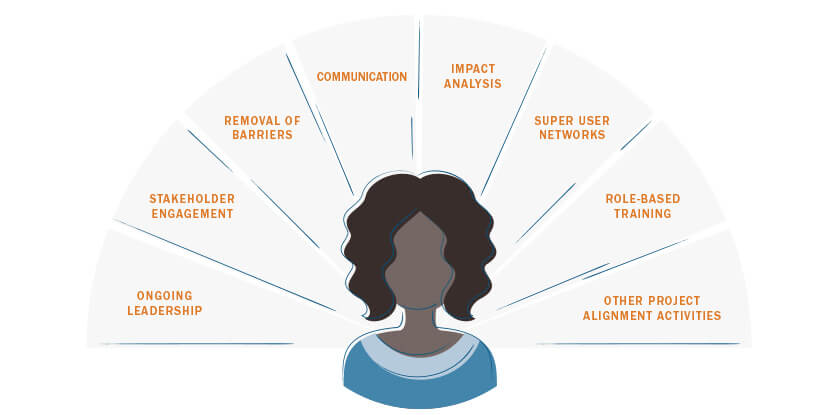
Leadership engagement
Involve senior leaders and management at all levels throughout the implementation process. Generally, end users believe, “If my leader doesn’t care, why should I?” That’s why it’s critical to bring in influencers and decision-makers early in the timeline, spending focused time framing and discussing the business case clearly to secure buy-in. Being clear about the resources you need to be successful, and articulating the impacts of not getting those resources (longer implementation time, lower quality, more issues, more help desk calls, longer hypercare, greater time-to-competence after Go Live, productivity loss after Go Live, etc.) is also key. Without the support and engagement of senior leaders and management, employees will experience misaligned priorities and won’t give the change the focus it needs.
Understand your influencers through a stakeholder analysis. Identifying who needs to be aligned across business functions and developing strategies and a cadence for gathering (and addressing) their input over time will help position your initiative for success.
Finally, don’t underestimate the importance of the frontline leader as a change enabler. Frontline leaders have both the budgeting authority to provide necessary resources and tools, and the decision-making authority to remove barriers to change where needed. It is always a good idea to position frontline managers as “change leaders” by engaging them regularly through their established channels, addressing concerns head on, and coaching them on how to actively guide their people toward new ways of working.
Change communications
Create a strategy and plan for transparent and ongoing communication from project launch through post-Go Live. Change communication is about taking people on the (sometimes bumpy) journey to adopt change over time. The key is to be transparent. You don’t have to have all the answers yet, but if you don’t intentionally shape the narrative, the proverbial “watercooler” will.
Put time into developing a compelling narrative for the change. You can avoid miscommunications by rooting the change story in WHY the change is needed. Once that’s understood, leverage clear, concise key messaging that’s light on conventional “business speak” to address the what, when, how, and who. By using empathy, we can put ourselves in the shoes of our audience groups and tailor supporting messages that will resonate with their perspective and help rally minds and hearts behind the desired future state. Consider not just end users but executives, managers, customers, vendors, application developers, project managers, and the larger project team (as the change team also often drives project team communication). The content should become increasingly more targeted and tactical as the project progresses and role-based change impacts are identified.
Leverage a variety of channels to effectively reach every audience. By tailoring your communications approach to how each audience most effectively receives information today, you’ll be able to create compelling stories and visuals that support clarity and info retention while cutting through the clutter. It’s so important to arm managers with the tools to easily reinforce your message—concise slides, talking points, graphics, one-pagers. With some qualitative and quantitative follow-up activities, it’s wise to confirm that cascaded communications are reaching those at all levels of the organization. Giving leaders and managers a “preview” of content before it is sent to their teams keeps them in the know and better prepared to address questions that arise.
Impact analysis
Document and articulate change impacts, then put that information to work. Identifying the “today” versus “tomorrow” view of processes, behaviors, roles, terminology, workload shifts, etc., is critical to set the scene for successful training and overall adoption. People need time to work through what’s coming. In advance of training, socialize critical information such as how things will look or feel different, so that people have space to ask questions and work through the natural emotions associated with change. They will then be able to focus on learning the “how” of the system and related processes during training and other learning events.
Help individuals understand how things are changing at different levels. When documenting impacts, include both the foundational, broad-scale, cross-functional changes that the new system will necessitate (data integration, standardized data conventions, data accuracy, etc.), as well as the more detailed change impacts by function and role, as appropriate. Consider how interactions between various company functions will change (not just how the system will be different), along with implications for customers and suppliers. Armed with a set of change impacts, you can then communicate these changes in digestible ways with progressive detail to ensure understanding around what’s changing, what tradeoffs will be required to be successful, what is needed from specific end users, and how to be successful using the new system and processes.
Reiterate key changes several times through different channels. This could look like meeting presentations, one-on-one role discussions, online reference material, digital posters, along with training events—whatever works for your environment and end users. Remember that often it’s less about “what’s in it for me,” and it’s more about “what’s in it for us” as an organization. Effective change impact communications help employees connect the dots to see that, when the organization does well, everyone benefits.
Super users
Designate a cross-functional group of strong performers to engage early and often with the system. Getting these knowledgeable users involved is CRITICAL to success, as they become valuable eyes and ears “on the ground.” As Super Users they may convey project updates; support solution design, configuration, and testing; inform and help deliver change impacts; answer system questions before and after Go Live; conduct instructor-led training; and gather and escalate feedback to the project team throughout the process. Consider how Super Users will be onboarded, supported, and enabled along the way, and create a steady cadence for touchpoints that combine project updates and two-way dialogue.
Make sure Super Users are appropriately seeded across the organization. When sizing the project team and Super User network, consider the number of end users, the level of change, and resource-intensive project phases (e.g. when testing overlaps with training).
Be very clear about the roles and responsibilities up front. One crucial step is to secure buy-in from Super User managers and business unit leaders regarding taking on this role, with an estimated percentage of the time it will take to do it well. Often it will be lighter on the front end, and the time investment increases with testing participation and before and after Go Live. Once your Super Users are confirmed, be sure to reiterate that time invested up front makes Go Live smoother and decreases time-to-competency after launch. And, for multi-year implementations with staggered Go Lives, don’t wait—bring the later-phase Super Users into the process early to build up-front experience and learnings. It may be tempting to keep them focused on their day-to-day until later, but this time investment can significantly increase the success of later launches.
Training & support
Align training to organizational needs for people readiness. After considering the type of learning needed – based on organizational learning preferences along with the technical and physical infrastructure – determine the right modality (eLearning, virtual, instructor-led, etc.) and curriculum. There will likely be a mix of foundational courses that everyone needs, as well as function- or role-specific courses that address specific processes. Your materials should provide big-picture context for processes up front—especially for ERP systems where upstream and downstream impacts are so significant. Remember to think through the support tools (job aids, quick reference guides, etc.) needed for end user practice and ensure that learners know which Super Users are available to help afterwards. If possible, leverage Super Users to deliver or directly support training events. Facilitating Train-the-Trainer sessions will position them for success.
Document how many processes or transactions need to be taught, and to which audiences. This will give you a rough estimate for the total amount of learning time, but this estimate almost always gets adjusted over time as new transactions, processes, and system characteristics are defined. If doing role-based training, inquire into the number of system security roles, with the understanding that while training roles need to closely align, there are generally fewer training roles than system roles.
Determine who will be responsible for training logistics. Even in the best of times, scheduling training for large-scale implementations can be a daunting task. To address coordination complexities, it’s important to identify who will be responsible for creating and managing the training schedule and invites, and what software or tool they will be using. For in-person training, know who will coordinate the details of the classroom (physical space, hardware/software and IT needs, room setup, managing print materials, etc.). Confirm availability of test data for hands-on practice during and after the sessions as well as how you’ll assess learners based on your objectives. This can range from instructor observation of transactions and thought processes to formal computer-based tests.
Measurement & evaluation
Align change management efforts to the business outcomes and success metrics defined for the overall initiative. In addition to tracking project-wide metrics over time, it takes a combination of qualitative and quantitative feedback mechanisms to gauge how adoption is going throughout a project and inform go-forward approaches or change management interventions to course correct and mitigate gaps.
When creating an evaluation strategy, make sure you can answer the following questions:
- What are we measuring?
- Who will measure it and how?
- When is the best time to measure it?
- What will we do with the results?
Deliver an end user change readiness survey after broadly communicating the “why.” This effort can help you gauge basic understanding of the business case while providing an early benchmark to compare progress against future surveys and project milestones (e.g. after change impact communications and training). Example readiness survey prompts include:
- “I understand why X initiative is important…”
- “I understand the high-level changes that X initiative will bring to my work…”
- “I know where to get help or ask questions about X…”
Consider separate Super User surveys to “check the pulse” of what this key group needs to be successful over time. Another option is to use demographics to build in specific questions for Super Users as part of broader end user survey completion. Qualitative insights from Super User meetings, executive committee meetings, and Stakeholder interviews should also be leveraged to continually improve change management efficacy. And, since there’s nothing worse than feeling like your feedback went into a black box, share out the key trends from the survey, including the high-level actions you’ll be taking to address what you heard.
Other key considerations
Manage between the lines of the project plan. Good change management involves deep involvement in the project, along with nuanced influencing at all levels. Project leaders need strong networks within the organization to marshal support, rally resources, and mitigate risks effectively.
Make readiness the criteria for Go Live. To avoid the mistake of managing only to budget and timeline, make data quality, systems readiness, and people readiness your drivers of a go/no-go decision. There’s always risk involved when going live, but the project team, project leaders, executives, and other stakeholders should all give the green light in a “go/no-go” meeting—so everyone feels ownership of the decision—before commencing cutover tasks.
Sustain the change by capturing success stories and reporting frequently on metrics post-launch. Individuals appreciate transparency about what’s working well and where you need to make adjustments, including where additional human support interventions may be needed.
Support and reward your project team. Take time to build a strong foundation for mutual trust and teamwork. Whether you’re an end user or project team member, implementations are not for the faint of heart. In all phases of the process, plan celebrations and rewards for the project team, Super Users, and end users to celebrate progress and key milestones on what is often a very long and arduous journey.
Bottom line: people readiness matters
The time, effort, and resources required to apply these people-focused principles will enhance your ability to deliver on the projected business outcomes of your implementation, while reducing the extent and duration of the inevitable productivity dip that should be expected and planned for after Go Live. That’s the power of driving people readiness through systems adoption.
Like these insights and want to read more? Check out the following insights on:
- Driving Adoption of Agile Sprints
- Driving Adoption of CRM Systems
- Driving Adoption of HCM Systems
- Driving Adoption of Microsoft 365
- People Readiness and ERP Implementations
If you’d like to connect with our team to learn more about preparing people for systems adoption, give us a call at 859-415-1000 or reach out through the form below.
Sustaining the Learning Journey Post-Event
Reinforcement is the most critical part of a learner’s journey.
 Sharon Boller – Affiliate Consultant
 When my daughter was 15, she almost put me in the hospital. Armed with a brand-new learner’s permit and a solid six hours of driving training, she panicked in traffic and attempted a left turn with oncoming traffic. As her passenger, it was clear that she needed lots more practice before attempting solo trips. That’s because learning is a journey, not a training event or class. (As I’m sure any parent whose kid is going through driver’s education can attest.)
Many organizations fund lots of events—product training, new-hire orientation, systems training, leadership workshops—yet these events alone fail to address what it takes to go from the delivery of knowledge or introduction of new skills to fluent recall and use of knowledge and skill. In most circumstances, it takes several repetitions, along with opportunities to practice, reflect, and explore more deeply. We all fall victim to the forgetting curve. According to research from the Bjork Learning and Forgetting Lab at UCLA, Our brain has a tendency to forget some to most of what goes into it in just a few days’ time unless we have additional practice and opportunity to recall information.
Just as my daughter was nowhere near ready to drive solo after six hours of practice, neither are most employees ready to perform at peak or even rudimentary proficiency after a single eLearning course or live workshop. The consequences of failing to plan out the entire learning journey are financial: wasted dollars spent on developing and delivering an incomplete learning solution and wasted time on the part of learners and designers, which indirectly goes to more wasted dollars.
So, how can you maximize the return on your training investment? How do you get beyond events to performance? You design and plan for it.
Here are a handful of solutions we have designed to help organizations go beyond a training event to sustained performance over time that produces measurable impact.
1. Implement a post-test or assessment.
Testing is a powerful form of retrieval practice. As we forget—and then must try to remember again—we strengthen our ability to recall. Games and post-event challenge activities offer creative, nontraditional ways to tap into the power of post-tests to provide learners with the elaborative practice they need to cement information and skill into long-term memory.
2. Provide digital job aids.
Cheat sheets, reference tools, or how-to guides housed in a central repository can help people bridge the gap between training day and first-time usage of a new process or skill. We helped NxStage create an app for patients that complements their in-person dialysis training with additional reinforcement and lessons, as well as knowledge checks and how-to resources. Patients get training in the dialysis center; then, the app enables them to practice recall and serves as a “just-in-time” reference when they are at home.
3. Provide reflection prompts.
There is no learning without reflection from learners on exactly what they learned and how it can be integrated into their work. Extremely motivated learners will reflect with no prompting. More typically, some prompting is useful. A manager can schedule a 1:1 conversation to elicit reflection within a week or two post-training, or periodically throughout a long-term training program that spans weeks or months. In self-managing environments, reflection can be prompted by a conversation with an accountability partner or via communication from the trainer. A video portal also can be set up for people to upload video reflections for wider sharing with an entire cohort.
4. Encourage success story sharing.
This form of reflection has tremendous “ripple power” because it leverages the power of social dynamics. In environments where people routinely meet in teams (sales teams, for example, or science labs), encourage people to share their success stories in applying skill or knowledge from a training. Invite people to share the situation; what specifically they applied from training; what happened; and what they learned. We set up a story-sharing portal for a client years ago when they implemented a major process change. The stories were hugely popular and drove further success as evidence accumulated of the benefits of the new process. You can do this informally by creating a social media, Slack, or Teams channel devoted to storytelling.
5. Encourage managers to offer feedback.
People need to know how they are doing—both good and bad. Provide managers with simple coaching tools and prompts (keep to one page, if possible) for managers to use in supporting feedback to employees. Coach managers in how to use the coaching tool. Don’t assume handing out a tool suffices in getting managers to use the tool. Schedule a short session to walk them through it and overview the learning journey their employees will participate in.
Reinforcement is the critical factor for a successful learning journey.
The next time you are designing a new training program, consider incorporating these five techniques to elevate it from an isolated learning event to an experience that drives proficiency and recall in the performance setting. After all, it takes more than just training to avoid those “oncoming traffic” moments. Sustain the learning journey post-event through reinforcement.
The People Impact of Reskilling and Upskilling
Upskilling or reskilling employees is essential to help them adapt more fluidly to change and the future of work. This article was co-authored by Anna Oskorus and Mike Divine.
TiER1 Performance Imagine the job you’re likely to have in five years doesn’t exist yet, and the job you’ll have in 10 years hasn’t been conceived yet. Many workers face this reality as businesses embark on digital transformations to integrate technology, data, systems, and people. To create new and improved capabilities that leverage and integrate the full power of digital networks, upskilling and reskilling employees is essential to help them adapt more fluidly to these challenges and prepare them for the future of work.
What is the impact for people?
The Big Picture: Jobs will shift. Total jobs available may increase, but some roles will disappear or be replaced by new skills and higher skilled labor (e.g., software programming, 3D modeling, or machine learning).
For Frontline Employees: If change is the norm for organizations, employee tasks will change on a daily if not hourly basis, making adaptability a critical skill. The existing workforce will require both advanced instruction (upskilling) and introduction to entirely new disciplines (reskilling). Learning will need to adapt as quickly as processes to keep employees up to speed with technology.
For Leadership Teams: A compelling narrative attracts and retains talent. Frame digital transformation as an integral part of an exciting and energizing career path. A true culture shift in people-machine interactions requires a fundamental shift in how every level of the organization views the people-machine interface. Adjust structures of people in ways that complement the adaptable and network-based design of the future organization.
What should you consider near term?
Align Leaders: Decide which aspects of digital transformation are high priority for the business. Continually orient leaders to the holistic set of priorities and which aspects are currently receiving focus and investment. Decision-making will require new streams of input from people and systems, requiring a higher level of transparency and feedback than is traditionally typical.
Communicate the Journey: Share the magnitude of the change to reduce the sense of threat. Prepare people for not just “a” change but for “continuous” change. Framing the change as a journey illustrates the value of ongoing change to the organization, employees, and customers, as well as what’s changing and why.
Map the Change: Many activities today need to radically change, including talent skillsets, behaviors, and disciplines. Determine and map the new skills or competencies needed for current and future roles. Additionally, plan how you will keep productivity consistent while implementing new technologies or competencies.
What should you consider longer term?
Learning: Provide continuous learning and onboarding to meet skill gaps and retain talent, including skills that are universal to the organization and role-specific skills.
Recruiting: Supplement the recruitment pipeline to prepare for new talent needs.
Labor Force Development: Establish training programs, apprenticeships, and public-private partnerships.
Systems: Invest in skills-based prescriptive learning systems that build skill profiles, identify skill gaps, accelerate learning, and provide content remediation.
Organization Design: Embed across the organization the ability to respond to constant change with agility.
Upskilling & reskilling in action
To inspire your journey, here are some of our favorite examples of how we’ve improved the performance of people through reskilling and upskilling.
Insurance for the Future
A large insurance firm wanted to build a learning culture in which a growth mindset and continuous learning were part of the day-to-day expectations for employees. Existing learning opportunities were housed across multiple platforms that were cumbersome to access, and associates either weren’t aware of available opportunities or weren’t taking advantage of them. Partnering with senior leaders and associates, we created a best-in-class experience focused on performance and aligned to core competencies with flexibility for associates to chase passion areas that excited them. Associates could own their journey—choosing between pre-curated learning pathways or manually adding relevant courses to their learning plan—to upskill at a time and place convenient for them.
Focusing on the Customer
A major telecommunications firm was transforming frontline sales support, in part by implementing a new system to optimize the customer experience and reduce the complexity of the user interface for the salesforce. Thousands of frontline sales team members needed to be reskilled using the system to help them better serve customers. Due to the more intuitive and intelligent nature of the new system, precious training time could be reallocated: less time learning the point-and-click navigation in a software environment, and more time learning how to create great technology-enabled customer experiences to connect customers with more products and services and better meet their needs.
Accelerating Paths to Employment
A community college sought our help with creating an online two-year associate degree program in Instructional Design and Learning Technology to accelerate the path to employment for its students. They also wanted to train faculty members on the fundamentals of instructional design and provide an apprenticeship support model to build online degree programs going forward. We partnered with faculty members to define a curriculum focused on essential skills for new instructional designers, as well as coaching them through building excellent online courses of their own. The college gained an award-winning online degree program AND a team of reskilled faculty members ready to convert more online degree programs and help the college grow.
Getting started with upskilling & reskilling
When implementing upskilling and reskilling solutions, it’s easy to let the big picture overwhelm you. One big challenge is that we just don’t know what’s to come. There are jobs and organizations of the future that don’t yet exist. Our advice is to start with small, lean experiments that you can learn from quickly and build upon overtime. And remember, you have to start somewhere. Let’s explore how we can develop the future workforce together!
While no perfect solution exists for any performance challenge, we specialize in helping our clients get unstuck, think deeply and efficiently about business challenges, and identify the best option for their situation. Fill out the form at the bottom of the page to learn more about our collaborative process.
Insights for Winning in the Talent Marketplace
A consistent, rigorous approach to talent management will prepare your organization for the next talent shift.
 Carol Henriques
 This article originally appeared in The Healthy, High-Performing Cultures Issue of Performance Matters Magazine. To request a print or digital copy of the magazine, click here.
Is your organization ready for the next shift in your talent marketplace?
Much like other markets, the talent marketplace abides by the laws of supply and demand. It also encompasses a complex, unique set of dynamics based on an organization’s need for talent (demand) and the pool of current and prospective talent with matching needs (supply).
Talent dynamics are always changing. There are inherent tensions when balancing organizational needs with talent market availability as well as important culture implications. From hiring and onboarding to training and development (and so much more), organizational culture significantly impacts and is impacted by the talent marketplace.
To win in the talent marketplace, leaders are being asked to:
- Create and activate a talent strategy that reflects their organization’s talent and cultural factors.
- Understand the organization’s anticipated strengths and gaps relative to current and future talent requirements.
- Respond to changes in the talent marketplace with agility and flexibility.
Every organization can benefit from a proactive, consistent approach to talent management that focuses on preparing for eventual market shifts while also maintaining cultural alignment within the organization. While every talent plan will be unique, there are three steps you can take to help your organization win in the talent marketplace.
1. Understand talent demand
If you want a clear picture of the key roles and competencies that will activate your organization’s business strategy, first take stock of forces that are driving talent demand—such as customer needs, changing industry dynamics, or new strategic initiatives. Also, note the critical people, leadership requirements, and performance standards needed to support the organization’s strategic objectives.
To further understand talent demands, analyze the organization’s plans as well as external trends for potential impacts to future business. In alignment with your organization’s values, identify and define the types of talent needed to ensure a capable and diverse organization. Identify critical capabilities needed to execute the business plan; then, define the roles and competencies necessary to create value for the business.
With the full understanding of these talent demands, you can start matching needs with the talent available externally and within your organization—based on your workforce supply.
2. Understand workforce supply
To realize the potential of your workforce supply, first map the external factors that provide important context for talent conversations happening within your organization. Assess the labor market for employment trends, regional growth projections, educational trends, and availability of diverse talent. Industry associations are another valuable source of talent data to support your external research, though more rigorous analysis of available talent in specialized areas of expertise may be necessary.
Then, look within the organization’s existing talent pool to understand current potential and performance. Through a talent inventory process, gather data on existing competency strengths and gaps relative to strategic, diversity, and capacity needs, as well as anticipated strengths or gaps due to potential turnover, promotions, and retirements. (We help clients integrate more consistent talent review processes in their organization so that they can continually assess talent strengths and gaps.) If a full workforce analysis is required, leverage data and analytics from your talent technology platform (if applicable). Finally, mine all the data for opportunities—and focus on roles with the greatest leverage across the organization.
Informed by the internal talent inventory and external research, you can match workforce supply with the organization’s talent demands. You’re also ready to identify areas of risk related to gaps in talent availability—and then build a plan to address the gaps.
3. Address talent gaps
Promoting, developing, and hiring great people are timeless talent strategies. Yet what’s critical and often overlooked is pulling the thread from business objective to talent requirements and gaps, and then surgically focusing promotion, development, and hiring on what you really need.
Closing gaps between talent demands and workforce supply requires targeted efforts to build the talent in roles that will have the greatest impact on business outcomes. Focusing your efforts will mean the right resources are in place at the right time for future shifts in the talent marketplace.
Promotion
Healthy, high-performing leaders focus on the strengths of their teams (individually and collectively) as well as considering their unique passions, interests, and growth goals when creating talent and succession plans. It’s more than performance—it’s also about helping employees connect their sense of purpose to the organization’s purpose.
While talent planning assesses someone’s capacity or potential for future performance, succession planning looks at key role(s) and requirements. Together, they provide a comprehensive picture of your talent, showing areas of strength as well as gaps or overlaps. Use your succession plan as a key resource in making talent decisions, so that career development pathways and lattices offer leaders a variety of opportunities—ones that address individual growth goals as well as organizational needs.
Developing
Competency gaps can become foundational opportunities for your organization’s development needs. (Conversely, if career development, learning, and organization development efforts lag the business needs, it’s likely that business objectives haven’t been translated into capabilities and competencies.)
By pulling through the talent requirements thread, you can create development systems, programs, and practices that are the best use of the organization’s resources—because you’re ensuring that people will be able to develop the skills, abilities, and leadership capacity to take on new challenges. This is how you create a talent-rich organization.
Hiring
Enthusiastic, talent-attraction “spin” and high applicant rates can be tempting when organizations need to meet staffing targets or face a talent shortage. Yet once people sign on, it can be tough for the organization to live up to the marketing hype—especially if there isn’t cultural alignment between the hype and reality.
When an employee joins the organization, the two enter an employment relationship that is assessed over time:
- How does this employee fit with where the organization is going?
- How does this organization fit with my needs and values?
- Is my talent recognized?
- Is this a safe and secure environment for me to flourish?
Make sure your company narrative is authentic to your organization’s culture so that everyone has a clear picture of the relationship they are entering. (To learn more about how culture impacts the employee experience, click here.)
A winning approach for talent management
Winning in the talent marketplace is possible—but it requires building rigor into your talent management process. First, you must understand your organization’s unique dynamics for workforce supply and talent demand to surface strengths, gaps, and overlaps. Then, address those gaps by promoting, developing, and hiring the talent that your organization really needs. This way, no matter how the talent marketplace shifts next, your organization will be ready.
This article originally appeared in The Healthy, High-Performing Cultures Issue of Performance Matters Magazine. To request a print or digital copy of the magazine, click here.
Use Career Skills Data To Elevate the Talent Experience
To leverage advanced, intelligent tools to elevate the talent experience, we need skills data.
 Jennifer Burnett
 This article originally appeared in The Data & Measurement Issue of Performance Matters magazine. Download a digital copy of the magazine to read more on this topic.
What if learning new skills and navigating your career was as simple and individualized as your experiences using smart apps in your personal life?
A key reason there is such a disparity between our personal and professional digital experiences is because collecting and managing data about employees is more complex than configuring an app. To leverage advanced, intelligent tools to elevate the talent experience, we need data that is simpler, clearer, commonly understood, and applicable to both the work and workers—that data element is skills.
Employee and job data reside in various organizational systems; they are not always accurate or current; and historically they’ve been used by companies to manage employees, not for employees to access and use themselves. Many organizations have used the job or position as the unit of measurement to organize data, and information about employees is related to the jobs they hold or perhaps the competencies related to the job. However, job and position data are often unreliable or incomplete, and competencies are typically very descriptive and not easy to use in intelligent applications.
To confidently use data to inform and enhance the talent experience, the data must be generated and curated using a rigorous, systematic, and disciplined process. Using skills data that are not only designed and defined specifically for the organization, but also confirmed and validated by employees and managers, enables the integrity, validity, and utility of the data to inform the human talent experience. Skills data allow us to more effectively connect information about work and workers, opening up new possibilities for a more agile and versatile talent experience.
Technology enables the use of skills
Skills-driven talent technology is an enabler of these data-informed experiences. Without the right framework, policies, and tools in place to enable the effective use of skills data, they’re just another data source.
There has been an explosion of skills tech fueling learning experience platforms, talent marketplaces, career growth and development tools, skills-based talent acquisition, and even skills-based compensation. The heart of these solutions relies on skills data, which are organized by skills taxonomies and ontologies and are connected to people, roles, jobs, learning content, development opportunities, gigs, projects, and more.
Organizations that use skills data in talent practices not only elevate the employee experience; their leaders are also able to utilize rich, reliable, accessible, and connected data to gain insights and greater visibility to the capabilities of their workforce. These insights allow leaders to identify and address current skills gaps and anticipate future skill needs. Utilizing skills that have been defined and structured the same way—regardless of whether they are connected to people, roles, jobs, or content—allows for more complex analysis and enables data-informed talent decisions.
Transitioning to skills-based talent practices
At the heart of a successful skills transformation is the employee. While skills technology can infer the skills a person possesses, the accuracy of those inferences must be curated and fine-tuned by each person. Employees are the owners of their own skills profile, and the quality and validity of the employee data determines the accuracy and relevancy of connections and recommendations for learning, development, mobility, and growth.
Much like data we provide in our personal lives to improve the experience we have in the intelligent apps and tools we use every day, the power over the data in an employee’s skills profile should remain with the person. We must continue to prioritize and respect the needs of data privacy, transparency, and oversight, while also providing a clear value proposition for employees to create and maintain a robust profile of themselves at work.
Using skills data in all or even just one of your talent practices is not a simple transition. In addition to data privacy, consider these essential components for a successful skills transformation:
- Recognizing what experience or process would benefit from a skills-based approach, and then which technology would enable that change.
- Navigating the shift in mindset and behaviors that accompany this change when employees and leaders are empowered by more transparent, personalized, and accessible data.
- Establishing governance and guidance for skills content, usage, integrity, and the ethical use of data.
- Clearly communicating to employees what information exists about them and how it is being used in compliance with relevant regulations.
Skills are still skills as we have known them for decades—from technical and functional skills to human and relational skills—but now they’re being used with greater intention and impact. The difference today is that skills now serve a new purpose as the data element enabling a connected and informed talent experience. Skills data is the common thread needed to fuel intelligent, advanced technology for talent decisions and to provide an elevated experience for today’s digitally sophisticated employees and leaders.
About the Author
Jennifer Burnett, PhD, is a Principal at TiER1 Performance where she provides guidance and actionable solutions to enterprise leaders seeking to advance their talent processes, technology, and people practices. With deep HR experience driving innovation and excellence in talent management, talent acquisition, people analytics, and strategic workforce planning, Jennifer’s mission in all engagements is to inspire and connect employees and positively impact business results.
Create Responsive Learning Programs with Design Thinking
As the world continues to change, there is a need for Learning and Development that meets learners where they are, no matter the context.
 Laura Fletcher – Director of Learning and Enablement at Salesforce
 Create Responsive Learning Programs With Design Thinking
In the spring of 2020, when stay-at-home orders went into place, I found myself going through a sudden transition: I had added two six-year-old “colleagues” to my home-office environment. This change turned previously manageable work meetings into a stressful juggling routine of trying to manage my household off-camera so I could look like a professional, well-oiled machine on-camera – not ideal conditions for productivity and focus.
Sudden changes can be difficult to manage, and many Americans abruptly saw a lot of them. While I and other professionals were adjusting to WFHWP (working from home while parenting), others were dealing with sick loved ones, isolation, and fear of job loss. For almost everyone, the context had changed.
In the world of Learning and Development, a new context can make training experiences that used to work suddenly ineffective or impractical. And while a global context shift like COVID-19 changes the game for everyone, individual learners are going through their own context shifts all the time. The spring of 2020 made it clear that the learning programs of the future need to be responsive—adaptable enough to meet each learner effectively, no matter what their environment, state of mind, stress levels, or priorities might be.
Think for a moment about all the ways your organization has changed in response to outside events. As you review your organization’s training initiatives, consider how the answers to these questions impact your materials:
- Is the information still relevant? When a big change happens, priorities shift drastically. In the wake of the pandemic, reskilling became an instantly pressing need. Initiatives that were essential months ago may have been deprioritized into oblivion. In the frantic rush to virtualize programs, program managers may not have stopped to consider (or ask) whether their programs were still relevant to the audience or their business.
- Is the delivery medium suited to a new context? Shortly after the stay-at-home order began, I participated in the pilot of a workshop redesigned for virtual delivery. The facilitator was great and the content was engaging, but I found myself dreading each session. Why? Each session was 3-4 hours long, and ignoring my parenting duties for a half day created family stress. A half-day session may have worked well when participants were in-person, but in a virtual environment it created stress and fatigue that detracted from the program’s goal. While trainers have been innovative in using electronic tools for training delivery, some skills warrant in-person practice that is difficult to simulate virtually. Not all programs will deliver the same results when the medium changes – their design may need to be rethought completely.
- Are learners struggling to care? A poll conducted by the Kaiser Family Foundation in April 2020 reported that 45 percent of adults said their mental health was affected by the pandemic. If a learner is experiencing a period of anxiety, depression, or extreme stress and fatigue, their motivation to engage in training activities or apply what they’ve learned can become compromised. And that’s a problem: as Dr. Ina Weinbauer-Heidel explains in her book, What Makes Training Really Work (2018), “If participants have no interest in applying what they have learned, transfer success is virtually impossible.”
To make training that’s responsive to learners’ changing realities, take a cue from design thinking. Design thinking is a human-centered problem solving approach that starts by gaining the perspective of the audience. Once you understand their reality, you can be much more confident that a solution will meet their needs and, ultimately, the needs of the business. There are four actions we can glean from a design thinking approach to help clarify learners’ new contexts and create responsive learning programs.
- Define your audience. This can be harder than it seems. Sometimes it’s an easy answer – for an onboarding program, for example, the answer might be “all new employees.” But pay attention if you struggle to come up with an answer or struggle to narrow your answer down. The program may not be relevant to anyone at the moment, or it may have multiple audiences that need different things from it. Now is not the time to perpetuate obsolete or overly-generic content.
- Gain perspective on learners’ context. Once you’ve defined the audience, it’s time to listen to them. This could take many forms – for example, maybe you have an existing learner persona that target learners can react to and modify, or perhaps your organization has done recent wellness surveys you can pull data from. Tools like an empathy map or focus group are easy to facilitate virtually, and can quickly yield meaningful data about what learners’ new normal means for them. Be sure to uncover what information is most relevant to them right now, clarify their preferences for format, and get a sense of the external pressures siphoning their attention.
- Give them a choice. Whenever possible, give people a choice. Autonomy is one of the key factors for motivation, (which in turn is essential to the learning process) so give your audience as much control as possible over when, where, how (or even IF) they participate. I took this approach with a program I was redesigning for virtual delivery. I sent a message to enrolled participants explaining the advantages of going virtual, as well as the commitment and engagement that modality requires. Then I let the participants re-decide whether they felt they were still in a place to realize that commitment and benefit. Happily, the majority of them affirmed their interest in the virtual program, and three of them deferred participation until the next cohort. It was great to take a pause and reevaluate not just what the program would offer to them, but what they could manage to bring to the program.
- Adopt a “perpetual pilot” mentality. Based on the current outlook, I can only assume the business landscape will continue to shift for the next year or more. The design thinking process involves prototyping and testing solutions before diving into development. Training and development must apply that strategy and acknowledge that – for now – many of our programs are an experiment. We no longer have the luxury of a “design, launch, maintain” process. Instead, we must keep an eye on the ongoing context changes and maintain the beginner’s mindset to learn and pivot after each iteration.
There are lots more ideas, tips, and tricks on how to implement a design thinking approach to learning in the book Sharon Boller and I wrote, Design Thinking for Training and Development. While it’s hard to find the time to implement new approaches, I also know that in my development process, I can’t afford inefficiency. Taking the time to understand the audience perspective and create responsive learning decreases the risk of developing solutions with no hope of reaching their goals, while also improving solutions’ relevance and usability.
A Recipe for Learning and Remembering
Training is only effective when employees can remember it. Use our recipe to ensure employees remember your key learning messages.
TiER1 Performance A Recipe for Learning and Remembering
It can be hard to know what amount of training is just right for your employees. Some learners get too little training. They sit through a few classroom sessions, see some slides, and get very little help at actually doing their job. Others get too much training. The list of required eLearning courses is too long, and actually takes them away from their responsibilities. The learning and remembering ends up happening outside of, or in spite of, the training requirement. Most organizations invest heavily in training their employees, yet employees still do not retain the critical knowledge they need to be successful. This is why some of our research has focused on why employees forget. How do our brains respond when we learn new information? Is there a pattern to forgetting?
Think about learning and remembering as a recipe.
The elements required for learning and remembering can fit together into a repeatable process. When used correctly, this process, or “recipe,” can yield our desired outcomes. Here’s a look at the entire recipe for learning and remembering:
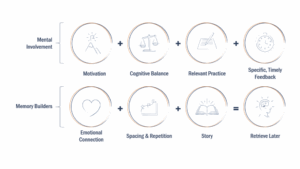
What elements are required to learn?
Before we can remember anything, we have to first learn it! Research (and experience) tells us that motivation, relevant practice, and specific, timely feedback are all required for learning … but that’s not the whole story. These are all essential parts of the learning process, but we have to take remembering into consideration to complete our recipe.
What elements are required to remember?
When you really want learners to remember your message, call on these four strategies:
- Spaced intervals
- Repetition
- Feedback
- Stories
One reason spacing works is that it eliminates the “glop.” When it comes to curriculum, too much = nothing. If you overload the learner with information, none of it will stick. Space the learning out and use repetitions to cement the content. Story, on the other hand, helps create context and an emotional response in the learner, both of which are proven to increase retention. This is one of the reasons that games can be such a powerful learning tool.
What’s the real recipe for learning and remembering?
Here are the ingredients:
1. Motivation: Employees/players/learners need to be motivated to learn. The most obvious way to do this is to incentivize them, and that can work, but that provides only extrinsic motivation. The best learning happens when the learner is intrinsically motivated. Think about what your learners might need to want to participate in the training. Could you make it more fun? Do they want to compete?
2. Relevant Practice: It is crucial that your learners practice. The saying “practice makes perfect” might be cliché, but it’s true. Think about ways you can encourage practice over time … and make sure it’s relevant to the goals you set.
3. Specific, Timely Feedback: Feedback is one of the most essential ingredients because it allows your learners to correct mistakes and stops them from building bad habits or repeating incorrect information. Behavioral psychology shows time and time again, however, that feedback must be specific and it must be quick, so that the learner can make the connection between the correct feedback and their mistake.
4. Spacing and Repetition: Now we’re getting into the ingredients that are crucial to long-term retention. Without repetition at strategically spaced intervals, learners will forget 30 – 90% of what they learn within 2-6 days’ time. Spaced repetition is the secret to fighting this “forgetting curve.”
5. Story: As stated above, story gives the learner context. It also creates an emotional element that will help them retrieve the information later. For example, it’s easier to remember safety guidelines when they’re delivered by a cartoon alien, whose mission is to keep your lab safe from invaders, than it is to remember those same guidelines when they’re given to you in a straightforward PDF.
If You Build It, They Will Come
How to win the talent game.
 Laura Hoppa – Principal Performance Consultant
 Your organization is a field of dreams for the right players. Build a valuable employee experience, tell the world about it, and it will bring them to your doors. That’s how you’ll score talented staff who will deliver your unique patient experience.
When it comes to attracting and retaining healthcare talent, too often our enthusiastic, talent-attraction “spin” sets people up for disappointment. Healthcare organizations are imperfect, the work we do is hard, and the industry itself is evolving and messy. So once people sign on, it can be pretty tough to live up to our own marketing hype. Sure, we engage in this self-promotion to attract more applicants— because we need to meet our staffing targets and there’s a shortage out there. But, rather than focusing on high applicant rates, we could focus on fewer applicants…with a stronger fit.
If we’re targeting excellent patient outcomes delivered through a brand-right patient experience, we need the right staff, and we need them to stay. That means people with excellent skills and credentials who embrace our mission. People who will love our facilities and our work, despite our crazy organizational challenges or quirky environment. People who want to be part of our solution, and don’t become disillusioned when things get tough. Those people aren’t easy to identify (much less onboard successfully) if we sweep our challenges under the rug.
Instead, we need to get real. It starts with identifying a true and transparent employee value proposition, or EVP. And then we need to make sure that EVP comes to life through intentional design of the employee experience.
While the idea may feel a bit uncomfortable—even scary—the results can be amazing. Here are four steps for drafting an EVP and then activating an employee experience so you build the committed, engaged, patient-centered workforce you need.
Write for today…and tomorrow.
Draft a description of your work environment that is authentic and will resonate with your ideal candidates. Be upfront about the truth of today, and balance it with your aspirations for tomorrow. Consider your reality and detail your differentiators—your culture, processes, relationships, norms, rewards, and benefits that specifically appeal to people with the character traits and values you desire. Include a glimpse of the future you’re striving for—describe a vision they can be part of building.
Design an employee experience that stands up to your EVP.
A well-crafted EVP makes a promise to employees, and that shouldn’t be taken lightly. Use it as a touchstone—a reference point for leaders to be sure they are managing and supporting people as intended. Consider all the important moments that matter to your workforce, and carefully architect how they should be experienced. Your EVP should also act as a north star for senior leadership, who should make certain that organizational strategy is never at odds with this description. The ability to continually live up to these words is critical to your organizational effectiveness and therefore, patient care.
Create an “opt-in” dynamic.
A great EVP details the generally unwritten rules between your organization and your employees; it makes explicit the balanced value-exchange you’re both entering into. It should be written as a give-get statement that lays out for people, “When you give us X, you’ll get Y.” Great EVPs describe the organization’s expectations for employees, while listing both the incredible aspects of the workplace as well as its challenges. It creates a moment for your workforce to sign on, eyes wide open; and that makes them more invested, committed, and resilient.
Use your EVP as an onboarding and coaching tool.
When an employee joins the organization, you’re basically striking a bargain together. And for the rest of their employment life cycle, that bargain gets subconsciously assessed by both sides. So, imagine if your managers used your honest, forthright EVP for coaching conversations that begin during onboarding and never stop. Managers could simply ask, “Where do you see yourself living up to this statement and where do you have room to grow? How about the organization—are we supporting you as described?” It’s an effective way to get ahead of problems, prevent resentment, and decrease unwanted turnover. With continued use, your EVP can be the catalyst that builds highly engaged teams—and that’s a true investment in the care of your patients.
OK, ready to take this on? When you write your EVP with honesty and live it with intention, your staff will return your sincerity with their trust, engagement, retention, and passion. It just takes the courage to build something great and share it truthfully. Then watch them come.
Benefits of Performance Experience Design
We use PXD when architecting solutions for organizations. It’s a way of solving daunting challenges with well-timed action, and it’s having notable impact on our clients.
Laura Hoppa – Principal Performance Consultant What is Performance Experience Design (PXD)? It’s the intentional design of experiences that change behaviors to get results. The approach focuses on galvanizing individuals and teams to “think, feel, and do” the precise things that will support their overall performance, well-being, and success—and achieve the company’s desired outcomes. PXD is entirely performer-centered in its methodology, but at the end of the day, it puts organizational leaders in the driver’s seat of taking action, at the right time and in the right way, to have impact.
Let’s break it down.
Have you ever found yourself looking forward, setting your sights on a new or elevated goal? We’re guessing you have—leaders regularly think about how and where their organization or team can perform better. “Better” might mean correcting an existing issue or problem, supporting the development of a particular role, or replicating a recent success. It could also mean a complete transformation of your function or company.
No matter what it looks like for you, the reality is that success is a group activity—it will require others, possibly entire teams and even cross-functional groups, to get aligned, and then change their behavior in both subtle and dramatic ways. Making this happen is where we often miss the boat—helping others change course isn’t easy. Humans are delightfully, beautifully, frustratingly complex. And influencing their growth and behavior is hard work. But it is possible to design an effective way forward using PXD.
PXD puts you in control in the right ways—where and when it matters.
When it comes to moving from plan to action, two mistakes are extremely common. The first is when leaders consider communicating the plan the same as activating the plan. Short story—it’s not; performers need more than just awareness to be successful.
The second is when leaders assume that achieving the desired result requires us to control (aka “direct” or “manage”) the performance of others. In fact, this unconscious belief sets us up to misplace our energy and undermine our own efforts. Because even as leaders, the only performance we can truly direct or manage is our own. PXD recognizes this. It’s based in the science of influence, not control.
It’s not rocket science—it’s human science. And in some ways, that’s harder.
Performance Experience Designers unpack the process of effectively inspiring and motivating others. Using PXD, they predict the emotional, intellectual, and behavioral journey your performers will need to travel to achieve your future vision.
The PXD approach starts with deep knowledge of, and empathy for, your specific employees’ reality and the factors that encourage their performance. And it balances this with an equally deep understanding for where you want your organization to go and why. Then it paints a real picture of how to get there by delivering a series of right-sized and right-timed experiences that will change hearts, minds, and actions.
The measurement framework is built in.
As you deliver the designed experience, you’ll want to know if it’s working as predicted, so an evaluation methodology is built-in to the PXD approach. At every step of the journey, you’ll be able to assess whether the journey is going as planned or needs a real-time adjustment. And frankly, adjustments are normal. We live in the real world, after all. And that means life is bound to throw us a few curve balls. Performance Experience Design is a nimble and responsive design technique that’s ready to help take your organization forward, measuring your success along the way.
Want to learn more about applying Performance Experience Design to your organization’s initiatives? Reach out to our team at 859-415-1000 or with our Let’s Talk form.