
 Katie Camargo – Chief Transformation Officer
 For a long time, organizational transformation looked like this: leaders benchmarked peer organizations, set a strategic vision for change, established clear success metrics, built a roadmap, and guided teams along a reasonably defined path to a fixed destination. This approach worked well in 2016, when the average employee experienced only two planned enterprise changes, such as a restructure or system implementation. By 2022, the number of planned enterprise changes that employees experienced throughout the year climbed to 10.
The shift from episodic to continuous change has redefined organizational transformation. Today, it’s more emergent, with highly interdependent change—often driven by forces outside the organization’s control—arriving faster and from multiple directions at once. It’s also more complex as evolving technologies, workforce and customer expectations, and market demands force organizations to adapt quicker and more often. Organizational transformation is no longer about managing discrete change initiatives. It’s about continuously assessing and adjusting the organizational system so that it can adapt to an environment that never stops evolving.
This reality is reshaping leadership too. Leaders are no longer architects of fixed futures who govern transformation with a three-year roadmap. Instead, they’re designers of adaptive systems that enable healthy performance through continuous, unpredictable change. This feels like a constant balancing act. Amid all the chaos, uncertainty, and fatigue that change fuels, leaders must make strategic decisions that will enable the organization to evolve and they must do so in a way that empowers people to live out the transformation even as the path to achieve the desired business outcomes shifts under their feet.
There’s no one “right” way to guide teams through emergent transformation. When partnering with leaders on this, we offer a holistic, people-centered approach that emphasizes continuously assessing seven interconnected performance levers that make up the organizational system—strategy, structure, talent, culture, systems and processes, roles, and leadership and governance—and intentionally adjusting them to enable stronger performance that supports the desired business outcomes and, ultimately, organizational transformation.
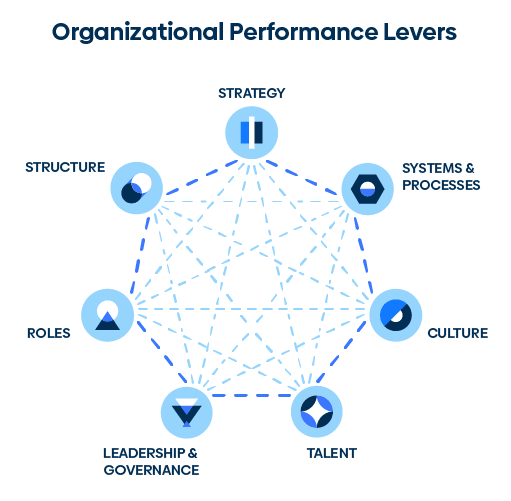
The point isn’t to optimize every lever simultaneously; instead, it’s to recognize which levers are misaligned to the intended transformation and make deliberate adjustments that strengthen organizational performance. When the performance levers work in harmony, they create the necessary conditions for transformation while ensuring people remain at the center and are empowered to perform.
Instead of measuring progress against a fixed endpoint (which rarely exists during emergent transformation), leaders must learn to interpret the signals that indicate the organizational system needs to be deliberately adjusted to strengthen performance and support the ongoing transformation. When the performance levers aren’t working in concert to support the intended business outcomes, signals show up as observable patterns and unintended consequences, like a dip in productivity, inconsistent ways of working, slowed growth, a decrease in customer satisfaction, or decision bottlenecks. Often, these signals become evident downstream, when an over-rotation on one lever impacts the other levers in the system. Like a domino effect, adjusting one performance lever will always impact the others in the system.
Brad Garlinghouse’s Peanut Butter Manifesto from 2006 offers an example of what it looks like when the system needs to be adjusted. An executive at Yahoo! at the time, Garlinghouse circulated a memo to employees in which he likened the company’s strategy to peanut butter. Specifically, he claimed that the company lacked a focused, cohesive vision because it wanted “to do everything and be everything to everyone,” which resulted in “a thin layer of investment spread across everything we do.”
Years later, in a 2013 LinkedIn post, Garlinghouse shared a realization that had become “painfully obvious” to him: The issues he’d highlighted were symptoms of a deeper problem. The company’s culture no longer encouraged and celebrated innovation with the same enthusiasm. In hindsight, the signals indicating that Yahoo!’s focus was fragmented had not yet been fully understood as a symptom of a broader cultural problem. Garlinghouse’s original memo identified important issues, including unclear ownership, bureaucracy, and decision-making by committee. Had Yahoo!’s leadership gone one step further and examined how the company’s systems, processes, and cultural norms were reinforcing these limiting behaviors, the organization might have been better positioned to change its trajectory.
Rather than treating signals as isolated problems to solve, effective leaders examine what they reveal about the underlying system, asking:
Then, they determine how to realign the performance levers to work in concert to create the conditions for sustained performance.
Waiting until the business is on the decline makes this realignment significantly harder, because resources are thinner, talent is more anxious, and the runway to make deliberate adjustments has shrunk. The leaders who navigate this best make ongoing data-informed adjustments while the organization is still healthy, preserving enough stability to adjust with precision, rather than react under pressure.
A healthcare client of ours did this well, and notably, they began this work while the organization wasn’t facing a significant market disruption, which lowered the urgency and gave them room to be intentional. They didn’t launch a sweeping transformation program. Instead, they defined and operationalized a small number of strategic intentions, set a clear strategic frame, and then committed to consistently re-evaluating where the organization needed to go to stay aligned with their desired outcomes. The discipline wasn’t in the plan but in the cadence of re-evaluation and in the autonomy they gave managers to make timely decisions without waiting for a policy to catch up.
We’ve also partnered with leaders as they navigate major market disruptions, from the proliferation of AI to the pressure to integrate emerging technologies into daily business operations. In one case, a client was facing a rapid shift in customer expectations as digital-first competitors reset the standard for speed, personalization, and ease of use. The organization recognized that responding to this shift would require more than implementing new tools; it would require aligning leaders, exploring new partnerships, redesigning workflows, building new capabilities, and helping employees adopt new ways of working.
Emergent transformation requires leaders to think systemically. Rather than trying to optimize every part of the system at once, they must continuously assess signals through the holistic lens of the seven performance levers, determine which levers matter most in the moment, and then intentionally bring those levers into alignment to position the organization for stronger performance. Every lever matters. The challenge is knowing which two or three levers to address first to create momentum, reduce friction, and enable the rest of the system to respond. Like an orchestra, transformation succeeds not because every instrument plays at full volume, but because each enters at the right moment to create a cohesive, harmonious performance.
It’s no longer possible to design a three-year transformation roadmap with meaningful specificity. What leaders can do is continuously revisit strategic decisions and make data-informed adjustments to the performance levers as new information arrives. For leaders guiding teams through emergent transformation, it boils down to this: your job isn’t to map the path to the future, but to create the conditions for people to walk it together. That’s the work. Let’s get started.
Use the Performance Levers Worksheet to examine a challenge your organization is facing through the lens of the seven performance levers. Looking for a partner to ensure your organization is designed to adapt and your people are equipped to perform through continuous change? We’d love to chat. Drop us a line in the form at the bottom of this page.