
 Carol Henriques – Principal Consultant
 Leaders are trained to solve complex problems: to experience a challenge, identify a cause, and take action to resolve the problem. But the signals that indicate a problem (e.g., productivity issues, decrease in market share, inconsistent ways of working, low customer satisfaction ratings) rarely reveal the full picture. There are almost always deeper interconnected issues impacting the organization, making it imperative for leaders to take a systems approach instead of treating signals as isolated problems.
Systems thinking asks leaders to resist the pull toward the obvious fix and instead ask a harder question: What does this signal reveal about the health of the whole organizational system?
When signals surface, leaders can take three actionable steps:
Transformation isn’t complete simply because a new technology is implemented, a merger closes, or a strategy launches. It happens when the organization performs differently in alignment with the intended transformation outcomes. Leaders who think systemically understand that every change they make to the organizational system creates a ripple effect, meaning if one performance lever is adjusted, the others will be impacted in some way.
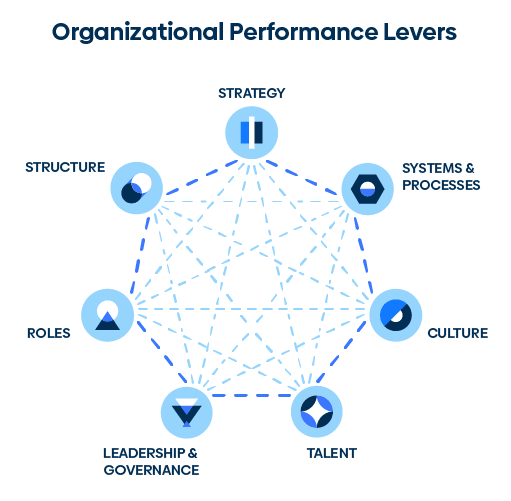
While every transformation ultimately touches all seven performance levers, effective leadership is the discipline of determining which actions to prioritize making first based on their potential impact, and how to orchestrate the rest of the system over time so that all levers are working in concert to support the intended transformation. By continuously monitoring the system and adjusting the levers, leaders create the conditions for sustained performance.
The following scenarios reflect patterns we’ve seen play out in various organizations. Each begins with a familiar transformation initiative and a reasonable approach but then signals surface, indicating a misalignment among the performance levers.
Scenario: An organization spent months preparing to deploy a new CRM (Customer Relationship Management) system and experienced a seamless technical rollout, thanks to a heavy focus on evolving organizational systems and processes. Mandatory training was delivered to upskill employees on the new technology during a pre-launch event.
Primary levers that leaders addressed: Systems & Processes; Talent
Signals that surfaced: Adoption rates remained subpar six months post-launch, usage was inconsistent across functions and roles, and productivity dipped.
Missed levers that needed attention:
The takeaway: People readiness needs to be a priority, not an afterthought at go-live. This requires adjusting the organizational system to not only support an effective implementation but to also enable stronger performance for those who are impacted by the system change. It’s key to engage managers early to help articulate the business case and model how to successfully use the technology with their teams. Clarifying role-specific performance expectations and reinforcing them beyond a one-time training event will bolster adoption, and super users can help build momentum from within cross-functional teams.
Scenario: After rolling out an enterprise AI strategy, an organization in a highly regulated industry equipped employees with access to a suite of AI tools and foundational AI literacy training, including critical thinking and prompt engineering skills. Leadership framed AI adoption as a competitive imperative and set expectations that all teams will integrate it into their daily workflows within the quarter.
Primary levers that leaders addressed: Strategy; Systems & Processes; Talent
Signals that surfaced: Months in, tool usage was sporadic and uneven, and the organization hadn’t seen measurable productivity gains or business impact from their AI investments. Employees reported confusion about when and how to use AI, and some shared concerns about what AI integration meant for the future of their roles.
Missed levers that needed attention:
The takeaway: Access to AI tools is not the same as AI adoption, and not every role will benefit from integrating AI in the same ways. A team’s level of AI proficiency should vary based on the nature of the work and how much of the team produces digital output that can be meaningfully augmented. Leaders should not only provide role-specific guidance on how and when to use AI in real project work, but they must also model responsible experimentation; reclassify and design work based on which activities should be automated, stay human, or be a collaboration between humans and AI; make space for questions about job security; and invest in building the habits and mindsets that enable people to use AI effectively and increase their proficiency.
Scenario: Two organizations complete a merger with significant attention paid to redesigning a new operating model, leadership structure, reporting lines, and roles. Legal, financial, and structural due diligence is thorough, and a detailed integration roadmap is executed on schedule and within budget. Throughout the process, leaders from both legacy organizations communicated the importance of the merger and the strategic vision for the new organization.
Primary levers that leaders addressed: Structure; Roles; Strategy
Signals that surfaced: Twelve to 18 months post-merger, revenue was down, voluntary turnover was higher than expected, collaboration between legacy teams remained siloed, and an “us versus them” dynamic persisted despite the structural integration being complete.
Missed levers that needed attention:
The takeaway: Successful integration requires cultural due diligence and intentionally integrating both legacy cultures. This involves shaping a shared identity and articulating the values that will define the new organization through a compelling company narrative that employees can connect to. Beyond modeling those new values, it’s critical that leaders provide process- and systems-level clarity on how employees are expected to collaborate in alignment with the new culture, operating structure, and strategic vision. Managers need to be upskilled on how to steward the new culture and support team members through the structural and cultural transition, and high-performing talent should be empowered as key enablers of new ways of working.
Scenario: An organization designed a new operating model and rolled out new processes, systems, tools, and team rituals across the business. Leaders were trained, improvement efforts were launched, and cross-functional teams were formed with intention.
Primary levers that leaders addressed: Structure; Systems & Processes; Talent
Signals that surfaced: Decisions continued to escalate up the hierarchy, speed didn’t improve, and leaders pulled people back into legacy reporting structures during high-pressure moments. Within a year, teams had reverted to old ways of working.
Missed levers that needed attention:
The takeaway: Organization design, at its core, is about organizing work in a way that supports the strategy an organization is seeking to achieve. The operating model serves as a blueprint that connects the “why” behind the strategy to how work gets done. To ensure alignment and shared ownership, it’s imperative for leaders to clearly define the strategic vision for the new operating model and articulate what success looks like under the new model. Then, after determining design objectives and principles based on what the new model needs to enable the organization to do, leaders should consider governance, high-level process flows, and ongoing business activity groupings required for each design objective. Once the operating model is in place, leadership, roles, and ways of working need to be refocused to support the new model. It’s also critical to assess what needs to be true about the organization’s culture to support the new model and adjust accordingly.
Scenario: To overhaul its customer experience (CX), an organization implemented a new CRM, redesigned customer journeys to reflect brand promise, and rolled out updated service protocols and feedback loops. The initiative was aligned to the organization’s strategic vision for growth and backed by executive sponsorship. Primary levers that leaders addressed: Systems & Processes; Strategy
Signals that surfaced: Customer satisfaction scores improved modestly, but net promoter score stayed flat and customer churn continued. Frontline employees delivered the new protocols inconsistently, and customers reported that interactions felt scripted rather than genuinely helpful.
Missed levers that needed attention:
The takeaway: Transforming CX requires investing in the people who impact customers, not just the systems and processes behind them. Employees need the right skills, mindsets, and behaviors to deliver authentic, consistent experiences that are aligned with the organization’s purpose and create meaning for customers. It’s critical for cross-functional teams to understand the high-impact moments within the customer journeys as well as the role each team member plays in building trust and loyalty in those moments. Leaders should model new customer-centric ways of working and articulate the organization’s brand promise through a compelling company narrative that aligns and energizes teams to deliver an intentional CX that connects people, processes, and purpose.
Use the Performance Levers Worksheet to examine a challenge your organization is facing through the lens of the seven performance levers. If you’re exploring how a systems approach could fuel your next major transformation, we’d love to chat. Drop us a line in the form at the bottom of this page.