
 Harrison Withers – Principal Consultant
 Most organizations have selected an AI model and tool, granted access to employees, and provided foundational training. This is where enterprise momentum around AI tends to stall, because, whether it’s explicitly stated or not, employees are often expected to figure out the rest.
For organizations to see measurable business impact from their AI investments, employees need clarity on what enterprise success (not just individual success) with AI looks like. Leaders can create this clarity by developing a clear strategy for integrating AI into work and then deliberately shaping the conditions that enable people to carry out that strategy.
Announcing intent around AI isn’t the same as developing and deploying an AI strategy. “We are going to become an AI-enabled organization” is a fundamentally different statement than “Over the next 90 days, we’re going to use AI in these ways to achieve these outcomes.” Without clarity around why, when, and how employees should use AI, everyone takes a different approach, which fuels inconsistency and mixed results.
A clear AI strategy is grounded in specific outcomes an organization is trying to accomplish through AI integration. The outcomes will depend on the type of work the organization does, the industry in which it competes, and the value it creates for customers. Instead of designing outcomes focused solely on increasing productivity or using AI to do the same work with fewer people, a more strategic approach is to align outcomes with what the organization can now do with AI that it couldn’t previously.
Exploring what’s possible with AI starts with asking: “If AI removes a constraint that has historically limited teams, what becomes possible? How might we invest that freed-up capacity in higher-value, more profitable work?” After clarifying what’s possible with the additional capacity AI can create, leaders can work backward to determine how to purposefully integrate AI into work and align teams to the outcomes the organization is driving.
Once the AI strategy has been clearly defined and articulated, the rest of the organizational system must be aligned to support it. This involves making deliberate changes to the interconnected levers that impact performance, including systems and processes, talent, roles, structure, leadership and governance, and culture. All performance levers must work in concert to create the conditions needed for an organization to achieve its AI outcomes.
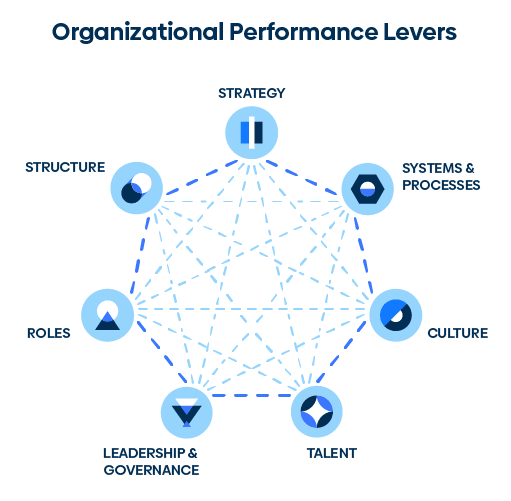
Leaders who think systemically understand that every change they make to the organizational system creates a ripple effect, meaning if one performance lever is adjusted, the others will be impacted in some way—making it imperative to continuously assess and adjust the system as conditions evolve. Below are some recommendations to keep in mind:
Systems and processes: These should be continuously refined based on feedback from the people impacted by the changes. AI capabilities are evolving too quickly to lock in a single system or approach. Instead, identify where AI integration can create the most business value, experiment with different tools and use cases in those areas, and build on what works. The key is to keep adapting as AI evolves.
Talent: Once employees are clear on the “why” and desired outcomes, they need the right communication, training, and reinforcement to sustainably adopt and integrate AI into their work. Instead of positioning adoption as an ultimatum, it’s important to emphasize the human judgement and expertise needed for effective AI use. Employees also need to be reassured that the goal isn’t to replace people but to help them work more efficiently.
Roles: Not every role will benefit from integrating AI in the same way. A person’s level of AI proficiency should vary based on the nature of their work and how much of it can be meaningfully augmented. Understanding where AI can be used to free up capacity requires leaders to reclassify work based on which activities should be automated, stay human, or be a collaboration between humans and AI. From there, role expectations around how and when to use AI become clearer, enabling people to shift their focus to more strategic, higher-value work.
Structure: Like roles, structure is where AI possibilities become real. Determining what the organization can accomplish through AI integration helps inform where and what needs to be restructured, from decision-making and reporting to operating models and accountability.
Leadership and governance: Like any organizational change, leaders who model how to practically use AI in everyday work will build more engagement, trust, and shared ownership among teams. To ensure responsible experimentation, employees need clear guardrails, and leaders must continue to evolve those boundaries as AI technology and how it’s used change.
Culture: When employees feel psychologically safe to ask questions, experiment, and learn from their mistakes, they’re more likely to build the habits and confidence needed to fully realize the organization’s AI strategy. Creating this environment starts with clarifying how AI connects to the organization’s mission and values, aligning rewards and recognition systems around responsible application, and emphasizing progress over perfection.
Want to dig deeper with Harrison or another TiER1 AI strategist? Complete the form at the bottom of this page, and we’ll be in touch.